


Page 116 - AN-3-3
P. 116
Advanced Neurology                                                   Evaluating plausibility of thalamic model


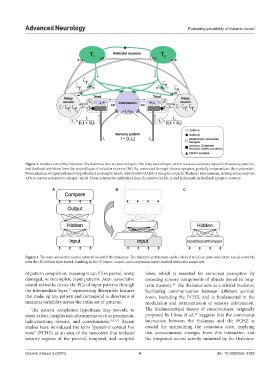
            Figure 2. Architecture of the thalamus. The thalamus has two neuron layers: The relay neuron layer, which receives excitatory inputs from sensory patterns,
            and feedback inhibition from the second layer of reticular neurons (Rs). Rs, connected through electric synapses, partially communicate their potentials.
            Normalization of input patterns is hypothesized in synaptic triads, with divisive GABA-A synaptic contacts. Thalamic interneurons, lacking axons, may use
            ADs to convey potential to synaptic triads. Usual subtractive inhibitions from Rs involve GABA-A and B channels in feedback synaptic contacts.

                       A                          B                            C


            Figure 3. The auto-associative neural network model of the thalamus. The thalamic architecture can be likened to (A) an auto-associative neural network,
            with the (B) hidden layer folded, resulting in the (C) input, output, and comparison layers stacked within the same layer.

            of pattern completion, meaning it can fill in partial, noisy,   lobes, which is essential for conscious perception by
            damaged, or incomplete input patterns. Auto -associative   encoding sensory components of objects stored in long-
            neural networks derive the PCs of input patterns through   term memory.  The thalamus acts as a critical mediator,
                                                                          34
            the intermediate layer,  representing discernible features   facilitating communication between different cortical
                              33
            that make up any pattern and correspond to directions of   zones, including the PCHZ, and is fundamental in the
            maximal variability across the entire set of patterns.  modulation and retransmission of sensory information.
              The pattern completion hypothesis may provide, to   The  thalamocortical  theory  of  consciousness,  originally
                                                                                    22
            some extent, insights into phenomena such as perception,   proposed by Llinás  et al.,  suggests that the continuous
            hallucinations, dreams, and consciousness. 10,12,22  Recent   interaction between the thalamus and the PCHZ is
            studies have introduced the term “posterior cortical hot   crucial for maintaining the conscious state, implying
            zone” (PCHZ) as an area of the neocortex that includes   that consciousness emerges from this interaction and
            sensory regions of the parietal, temporal, and occipital   the integrated neural activity sustained by the thalamus.


            Volume 3 Issue 3 (2024)                         4                                doi: 10.36922/an.3188

