


Page 117 - AN-3-3
P. 117
Advanced Neurology                                                   Evaluating plausibility of thalamic model


            Clinical and experimental studies demonstrate that the   stabilized images not only depict a phenomenon localized
            thalamus controls the alternation and level of wakefulness   to the eye but also involve higher brain areas.
            and sleep states, 35-37  with lesions in the non-specific   Llinás et al.  initial proposal on resonant columns was
                                                                           22
            pathways 38,39  often resulting in loss of consciousness.   pioneering in attempting to computationally understand
            Cortical layer V pyramidal neurons, which have extensive   the functioning of thalamocortical networks. Subsequently,
            connections with the thalamus, are central to this theory,   various models emerged, exploring the different operational
            implying that any cortical processing excluding these   contexts of this circuit. 41-44  Han  et  al.  developed a
                                                                                                 45
            neurons will be unconscious. Stimulation of neurons in   computational model based on multi-scale recurrent neural
            the centrolateral nucleus of the thalamus in anesthetized
            primates restores the wakeful state, suggesting clinical   networks  with synaptic  depression to  elucidate novelty
            applications for alleviating consciousness disorders. 36,37  detection in the whisker-related region (barrel cortex) of
                                                               the rat somatosensory thalamocortical circuit. Meanwhile,
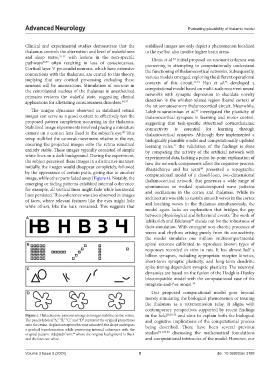
              The unique dynamics observed in stabilized retinal   Lakshminarasimhan  et al.  investigated the plasticity of
                                                                                    46
            images can serve as a good context to effectively test the   thalamocortical synapses in learning and motor control,
            proposed pattern completion occurring in the thalamus.   suggesting that task-specific structured corticothalamic
            Stabilized image experiments involved placing a miniature   connectivity  is  essential  for  learning  through
            camera on a contact lens fixed in the subject’s eye.  This   thalamocortical synapses. Although they implemented a
                                                     40
            setup nullified the camera’s movement relative to the eye,   biologically plausible model and computationally updated
            ensuring the projected images onto the retina remained   learning  rules,   the  validation  of  the  findings  is  done
                                                                           47
            entirely stable. These images typically consisted of simple   by comparing the activity of the artificial network with
            white lines on a dark background. During the experiment,   experimental data, lacking a point-by-point explanation of
            the subject perceived these images in a distinctive manner:   how the network components affect the cognitive process.
            initially, the images would disappear completely, followed   Bhattacharya and his team  presented a topographic
                                                                                      48
            by the appearance of certain parts, giving rise to another   computational  model  of  a  closed-loop,  two-dimensional
            image, while other parts faded away (Figure 4). Notably, the   thalamocortical network that generates a wide range of
            emerging or fading patterns exhibited internal coherence;   spontaneous or evoked spatiotemporal wave patterns
            for example, all vertical lines might fade while horizontal   and oscillations in the cortex and thalamus. While its
            lines persisted. This coherence was also observed in images   architecture was able to sustain smooth waves in the cortex
            of faces, where relevant features like the eyes might fade   and lurching waves in the thalamus simultaneously, the
            while others, like the hair, remained. This suggests that
                                                               model  again  lacks  an  explanation  that  bridges  the  gap
                                                               between physiological and behavioral events. The work of
            A
                                                               Izhikevich and Edelman  stands out for the robustness of
                                                                                  20
                                                               their simulation. With emergent non-chaotic processes of
                                                               waves and rhythms arising purely from its connectivity,
                                                               the model simulates one million multicompartmental
            B                                                  spinal  neurons  calibrated  to  reproduce  known  types  of
                                                               responses recorded  in vitro in rats. It has almost half a
                                                               billion synapses, including appropriate receptor kinetics,
                                                               short-term  synaptic  plasticity,  and  long-term  dendritic
            C                                                  spike-timing-dependent synaptic plasticity. The neuronal
                                                               dynamics are based on the fusion of the Hodgkin-Huxley
                                                               biocompatible model with the computational ease of the
                                                               integrate-and-fire model. 49
             D                                                   Our proposed computational model goes beyond
                                                               merely simulating the biological phenomenon or treating
                                                               the thalamus as a retransmission relay. It aligns with
                                                               contemporary perspectives supported by recent findings
            Figure 4. Hallucinatory patterns emerge as images stabilize on the retina.   in the field 28,50-52  and aims to explain both the biological
            The panels labeled “A,” “B,” “C,” and “D” represent the original projections   and cognitive implications of the computational process
            onto the retina. As photoreceptors become saturated, the shape undergoes   being  described. There  have  been  several  previous
            a gradual transformation while preserving internal coherence with the   8,11,53,54
            original pattern. Adapted from,  where the original background is black   studies   discussing the mathematical foundations
                                40
            and the lines are white.                           and computational intricacies of the model. However, our

            Volume 3 Issue 3 (2024)                         5                                doi: 10.36922/an.3188

