


Page 122 - AN-3-3
P. 122
Advanced Neurology                                                   Evaluating plausibility of thalamic model


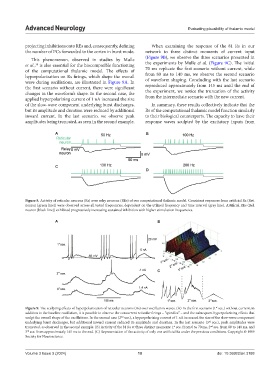
            projecting inhibitions onto REs and, consequently, defining   When examining the response of the 81 Rs in our
            the number of PCs forwarded to the cortex in burst mode.  network to three distinct moments of current input
              This phenomenon, observed in studies by Mulle    (Figure 9B), we observe the three scenarios presented in
            et al.,  is also essential for the biocompatible functioning   the experiments by Mulle  et al. (Figure  9C). The initial
                30
            of the computational thalamic model. The effects of   70 ms replicate the first scenario without current, while
            hyperpolarization on Rs firings, which shape the overall   from 80 ms to 140 ms, we observe the second scenario
            wave during oscillations, are illustrated in Figure 9A. In   of waveform shaping. Concluding with the last scenario
            the first scenario without current, there were significant   reproduced approximately from 145 ms until the end of
            changes in the waveform’s shape. In the second case, the   the experiment, we notice the truncation of the activity
            applied hyperpolarizing current of 1 nA increased the size   from the intermediate scenario with the new current.
            of the slow-wave component underlying burst discharges,   In summary, these results collectively indicate that the
            but its amplitude and duration were reduced by additional   Rs of the computational thalamic model function similarly
            inward current. In the last scenario, we observe peak   to their biological counterparts. The capacity to have their
            amplitudes being truncated, as seen in the second example.  response waves sculpted by the excitatory inputs from

                         A                                     B


                         C
                                                               D


            Figure 8. Activity of reticular neurons (Rs) over relay neurons (REs) of our computational thalamic model. Consistent responses from artificial Rs (Ret.
            neuron [green line]) were observed across all tested frequencies, dependent on the utilized frequency and time interval (grey line). Artificial REs (Rel.
            neuron [black line]) exhibited progressively increasing sustained inhibition with higher stimulation frequencies.

                         A                                          B


                                                                    C


            Figure 9. The sculpting effects of hyperpolarization of reticular neurons (Rs) over oscillation waves. (A) In the first scenario (1  sce.) without current, in
                                                                                             st
            addition to the baseline oscillation, it is possible to observe the concurrent reticular firings – “spindles” – and the subsequent hyperpolarizing effects that
                                                    nd
            sculpt the overall shape of the oscillations. In the second case (2  sce.), a hyperpolarizing current of 1 nA increased the size of the slow-wave component
            underlying burst discharges, but additional inward current reduced its amplitude and duration. In the last scenario (3  sce.), peak amplitudes were
                                                                                          rd
                                                                           st
            truncated, as observed in the second example. (B) Activity of the 81 Rs at three distinct moments: 1  sce. From 0 to 70 ms, 2  sce. from 80 to 140 ms, and
                                                                                           nd
            3  sce. from approximately 145 ms to the end. (C) Representation of the activity of only one artificial Rs under the previous conditions. Copyright © 1999
             rd
            Society for Neuroscience.
            Volume 3 Issue 3 (2024)                         10                               doi: 10.36922/an.3188

