


Page 77 - AN-3-3
P. 77
Advanced Neurology                                                            mTOR inhibition in epilepsy


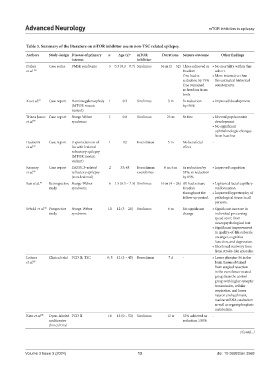
            Table 3. Summary of the literature on mTOR inhibitor use in non‑TSC related epilepsy.
            Authors   Study design Disease of primary   n  Age (y) a  mTOR   Durationa  Seizure outcome  Other findings
                                interest                   inhibitor
            Parker    Case series  PMSE syndrome  5  0.3 (0.3 – 0.7) Sirolimus  36 m (5 – 52) Three achieved sz  •  No mortality within this
            et al.  80                                                         freedom      cohort.
                                                                               One had sz   •  More interactive than
                                                                               reduction by 75%  the untreated historical
                                                                               One remained   counterparts.
                                                                               sz freedom from
                                                                               birth
            Xu et al. 81  Case report  Hemimegalencephaly   1  0.3  Sirolimus  3 m  Sz reduction   • Improved development
                                (MTOR mosaic                                   by>50%
                                variant)
            Triana Junco  Case report  Sturge Weber   1  0.8  Sirolimus  23 m  Sz free     •  Normal psychomotor
            et al. 92           syndrome                                                    development
                                                                                           •  No significant
                                                                                            ophthalmologic changes
                                                                                            from baseline
            Hadouiri    Case report  Hypomelanosis of   1  12  Everolimus  5 m  No beneficial   -
            et al. 82           Ito with lesional                              effect
                                refractory epilepsy
                                (MTOR mosaic
                                variant)
            Kearney    Case report  DEPDC5-related   2  33; 48  Everolimus;   6 m; 6 m  Sz reduction by   • Improved cognition
            et al. 89           refractory epilepsy        everolimus          33%; sz reduction
                                (non-lesional)                                 by 85%
            Sun et al. 93  Retrospective  Sturge-Weber   6  1.5 (0.5 – 7.5) Sirolimus  16 m (4 – 26) All had seizure   •  Lightened facial capillary
                      study     syndrome                                       freedom      malformation
                                                                               throughout the   •  Improved hypertrophy of
                                                                               follow-up period.  pathological tissue in all
                                                                                            patients.
            Sebold et al. 94  Prospective   Sturge-Weber   10  12 (5 – 20)  Sirolimus  6 m  No significant   •  Significant increase in
                      study     syndrome                                       change       individual processing
                                                                                            speed score from
                                                                                            neuropsychological test.
                                                                                           •  Significant improvement
                                                                                            in quality-of-life subscale
                                                                                            on anger, cognitive
                                                                                            function, and depression.
                                                                                           •  Shortened recovery time
                                                                                            from stroke-like episodes.
            Leitner    Clinical trial  FCD II; TSC  9; 5  12 (3 – 45)  Everolimus  7 d  -  •  Lower phospho‑S6 in the
            et al. 83                                                                       brain tissues obtained
                                                                                            from surgical resection
                                                                                            in the everolimus-treated
                                                                                            group than the control
                                                                                            group with higher synaptic
                                                                                            transmission, cellular
                                                                                            respiration, and lower
                                                                                            neuron ensheathment,
                                                                                            nuclear mRNA catabolism
                                                                                            as well as organophosphate
                                                                                            metabolism.
            Kato et al. 85  Open-labeled  FCD II  16  13 (0 – 53)  Sirolimus  12 w  33% achieved sz   -
                      multicenter                                              reduction ≥50%
                      clinical trial
                                                                                                       (Contd...)


            Volume 3 Issue 3 (2024)                         13                               doi: 10.36922/an.3568

