


Page 73 - AN-3-3
P. 73
Advanced Neurology                                                            mTOR inhibition in epilepsy


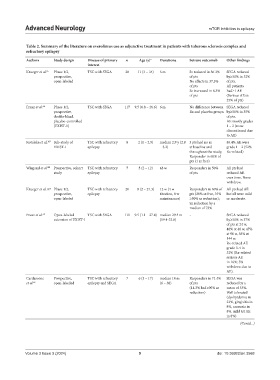
            Table 2. Summary of the literature on everolimus use as adjunctive treatment in patients with tuberous sclerosis complex and
            refractory epilepsy
            Authors     Study design  Disease of primary   n  Age (y) a  Durationa  Seizure outcomeb  Other findings
                                      interest
            Krueger et al. 65  Phase 1/2,   TSC with SEGA  28  11 (3 – 34)  6 m   Sz reduced in 56.3%   SEGA reduced
                        prospective,                                              of pts         by≥50% in 32%
                        open-labeled                                              No effects in 37.5%   of pts.
                                                                                  of pts         All patients
                                                                                  Sz increased in 6.3%   had≥1 AE
                                                                                  of pts         (Serious AE in
                                                                                                 25% of pts)
            Franz et al. 66  Phase 1/2,   TSC with SEGA  117  9.5 (0.8 – 26.6) 6 m  No difference between  SEGA reduced
                        prospective,                                              Rx and placebo groups by≥50% in 35%
                        double-blind,                                                            of pts.
                        placebo-controlled                                                       AE mostly grades
                        (EXIST-1)                                                                1 – 2 (none
                                                                                                 discontinued due
                                                                                                 to AE)
            Kotulska et al. 107  Sub-study of   TSC with refractory   8  2 (1 – 2.9)  median 2.9 y (2.8  3 pts had no sz   89.4% AE were
                        EXIST-1       epilepsy                       – 3.2)       at baseline and   grade 1 – 2 (52%
                                                                                  throughout the study;  Rx-related)
                                                                                  Responder in 60% of
                                                                                  pts (1 sz free)
            Wiegand et al 108  Prospective, cohort   TSC with refractory   7  5 (2 – 12)  48 w  Responders in 50%   All pts had
                        study         epilepsy                                    of pts         reduced AE
                                                                                                 over time. None
                                                                                                 withdrew.
            Krueger et al. 67 Phase 1/2,   TSC with refractory   20  8 (2 – 21.3)  12 w (4 w   Responders in 60% of  All pts had AE
                        prospective,   epilepsy                      titration, 8 w   pts (20% sz free, 35%   but all were mild
                        open-labeled                                 maintenance)  ≥90% sz reduction);  or moderate.
                                                                                  Sz reduction by a
                                                                                  median of 73%
            Franz et al. 68  Open-labeled   TSC with SEGA  111  9.5 (1.1 – 27.4) median 29.3 m   -  SEGA reduced
                        extension of EXIST-1                         (19.4-33.8)                 by≥50% in 37%
                                                                                                 of pts at 24 w,
                                                                                                 46% at 48 w, 47%
                                                                                                 at 96 w, 38% at
                                                                                                 144 w.
                                                                                                 Rx-related AE
                                                                                                 grade 3-4 in
                                                                                                 32% (Rx-related
                                                                                                 serious AE
                                                                                                 in 16%; 5%
                                                                                                 withdrew due to
                                                                                                 AE).
            Cardamone    Prospective,   TSC with refractory   7  6 (3 – 17)  median 18 m    Responders in 71.4%   SEGA was
            et al. 63   open-labelled  epilepsy and SEGA             (6 – 38)     of pts         reduced by a
                                                                                  (14.3% had≥90% sz   mean of 33%.
                                                                                  reduction)     Well tolerated
                                                                                                 (dyslipidemia in
                                                                                                 23%, gingivitis in
                                                                                                 8%, anorexia in
                                                                                                 8%, mild GI AE
                                                                                                 in 8%)
                                                                                                       (Contd...)


            Volume 3 Issue 3 (2024)                         9                                doi: 10.36922/an.3568

