


Page 72 - AN-3-3
P. 72
Advanced Neurology                                                            mTOR inhibition in epilepsy


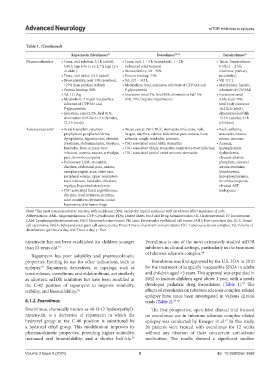
            Table 1. (Continued)
                               Rapamycin (Sirolimus) 51             Everolimus 52‑54            Temsirolimus 55
            Pharmacokinetics  •  Tmax, oral solution: 2.1 h (adult);   •  Tmax, oral: 1 – 3 h (transplant), 1 – 2 h    •  Tmax, Temsirolimus:
                            5.88 h (age 6 to 11 y); 2.7 h (age 12 y   (advanced solid tumors)  0.5 h (1 – 2.5 h
                            or older)                • Bioavailability: 20 – 36%              sirolimus, primary
                           • Tmax, oral tablet: 3.5 h (adult)  • Protein binding: 74%         metabolite)
                           •  Bioavailability, oral: 14% (solution),   • Vd: 107 – 342 L     • Vd: 172 L
                            >27% than solution (tablet)  •  Metabolism: liver, extensive, substrate of CYP3A4 and   •  Metabolism: hepatic,
                           • Protein binding: 92%     P-glycoprotein                          substrate of CYP3A4
                           • Vd: 12 L/kg             •  Excretion: renal 5%, feral 80%, elimination half‑life    •  Excretion: renal
                           •  Metabolism: 7 major metabolites,   30 h, 79 h (hepatic impairment)  4.6%, fecal 78%,
                            substrate of CYP3A4 and                                           total body clearance
                            P-glycoprotein                                                    16.2 L/h (adult),
                           •  Excretion: renal 2.2%, feral 91%,                               elimination half-life
                            elimination half-life 61.3 h (female),                            17.3 h (adults), 31 h
                            72.3 h (male)                                                     (children)
            Adverse reactions a  •  Renal transplant rejection   •  Breast cancer, NET, RCC: stomatitis, infections, rash,   •  Rash, asthenia,
                            prophylaxis: peripheral edema,   fatigue, diarrhea, edema, abdominal pain, nausea, fever,   mucositis, nausea,
                            dyslipidemia, hypertension, elevated   asthenia, cough, headache, anorexia  edema, anorexia
                            creatinine, abdominal pain, diarrhea,  • TSC‑associated renal AML: stomatitis  •  Anemia,
                            headache, fever, urinary tract   • TSC‑associated SEGA: stomatitis, respiratory tract infection  hyperglycemia,
                            infection, anemia, nausea, arthralgia,  • TSC‑associated partial‑onset seizures: stomatitis  dyslipidemia,
                            pain, thrombocytopenia                                            elevated alkaline
                           •  Pulmonary LAM: stomatitis,                                      phosphate, elevated
                            diarrhea, abdominal pain, nausea,                                 serum creatinine,
                            nasopharyngitis, acne, chest pain,                                lymphopenia,
                            peripheral edema, upper respiratory                               hypophosphatemia,
                            tract infection, headache, dizziness,                             thrombocytopenia,
                            myalgia, hypercholesterolemia                                     elevated AST,
                           •  TSC‑associated facial angiofibroma:                             leukopenia
                            dry skin, local irritation, pruritus,
                            acne, acneiform dermatitis, ocular
                            hyperemia, skin hemorrhage
            Note:  The most common adverse reaction with incidence ≥30%, except for topical sirolimus with an adverse effect incidence of ≥1%.
                a
            Abbreviations: AML: Angiomyolipoma; CYP: Cytochrome; FDA: United States Food and Drug Administration; GI: Gastrointestinal; IV: Intravenous;
            LAM: Lymphangioleiomyomatosis; NET: Neuroendocrine tumor; PEComa: Perivascular epithelioid cell tumor; POD: Post-operation day; RCC: Renal
            cell carcinoma; SEGA: Subependymal giant cell astrocytoma; Tmax: Time to maximum concentration; TSC: Tuberous sclerosis complex; Vd: Volume of
            distribution; qd: Once a day; bid: Twice a day; y: Year.

            rapamycin has not been established for children younger   Everolimus is one of the most extensively studied mTOR
            than 13 years old. 51                              inhibitors in clinical settings, particularly in the treatment
              Rapamycin  has  poor  solubility  and  pharmacokinetic   of tuberous sclerosis complex. 64
            properties, limiting its use for other indications, such as   Everolimus was first approved by the U.S. FDA in 2010
            epilepsy.  Rapamycin derivatives, or rapalogs, such as   for the treatment of surgically inaccessible SEGA in adults
                   59
            temsirolimus, everolimus, and ridaforolimus, act similarly   and children aged ≥3 years. This approval was expanded in
            as allosteric mTOR inhibitors but have been modified at   2012 to include children aged above 1 year, with a newly
                                                                                                        53
            the C-42 position of rapamycin to improve solubility,   developed pediatric drug formulation (Table  1).  The
            stability, and bioavailability. 59                 effects of everolimus on tuberous sclerosis complex-related
                                                               epilepsy  have since  been investigated in various clinical
            6.1.2. Everolimus                                  trials (Table 2). 65-68
            Everolimus, chemically known as 40-O-(2-hydroxyethyl)-  The first prospective, open-label clinical trial focused
            rapamycin, is a derivative of rapamycin in which the   on everolimus use in tuberous sclerosis complex-related
            hydroxyl group at the C-40 position is substituted by   epilepsy was conducted by Krueger et al.  In this study,
                                                                                                 67
            a hydroxyl ethyl group. This modification improves its   20  patients were treated with everolimus for 12  weeks
            pharmacokinetic properties, providing higher solubility,   without any titration of their concurrent anti-seizure
            increased oral bioavailability, and a shorter half-life.    medication. The results showed a significant median
                                                         58

            Volume 3 Issue 3 (2024)                         8                                doi: 10.36922/an.3568

