


Page 78 - AN-3-3
P. 78
Advanced Neurology                                                            mTOR inhibition in epilepsy


            Table 3. (Continued)
            Authors   Study design Disease of primary   n  Age (y) a  mTOR   Durationa  Seizure outcome  Other findings
                                interest                   inhibitor
            Moloney    Open-labeled  GATOR1-related   5  35 (15 – 49) Everolimus  12 m (7 – 31) Three achieved   -
            et al. 90  observational  epilepsy (non-lesional)                  sz reduction
                      study      • DEPDC5, n=4                                 by 74.3-86.1%
                                 • NPRL3, n=1                                  (DEPDC5 LoF
                                                                               variant).
                                                                               One achieved
                                                                               sz reduction by
                                                                               43.9% (DEPDC5
                                                                               missense variant).
                                                                               One had no
                                                                               improvement
                                                                               (NPRL3).
            Shiraishi    Case report  FCD II   1      2    Sirolimus    92 w   Sz reduction by   -
            et al. 84                                                          95%
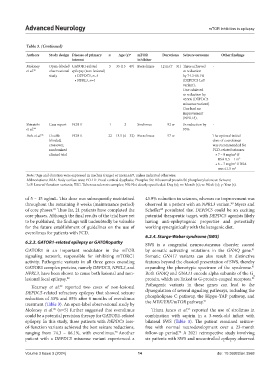
            Park et al. 86  Double-   FCD II   22  13.5 (4 – 32) Everolimus  57 w  -        The optimal initial
                      blinded,                                                              dose of everolimus
                      crossover,                                                            was recommended for
                      randomized                                                            FCD-related seizures
                      clinical trial                                                         •  7 – 9 mg/m  if
                                                                                                     2
                                                                                              BSA 0.5 – 1 m 2
                                                                                             •  6 – 7 mg/m  if BSA
                                                                                                     2
                                                                                              was ≤1.5 m 2
            Note:  Age and duration were expressed in median (range) or mean±SD, unless indicated otherwise.
                a
            Abbreviations: BSA: Body surface area; FCD II: Focal cortical dysplasia; Phospho-S6: Ribosomal protein S6 phosphorylation; sz: Seizure;
            LoF: Loss-of-function variants; TSC: Tuberous sclerosis complex; NS: Not clearly specified; d: Day (s); m: Month (s); w: Week (s); y: Year (s).

            of 5 – 15 ng/mL. This dose was subsequently maintained   43.9% reduction in seizures, whereas no improvement was
            throughout the remaining 8 weeks (maintenance period)   observed in a patient with an NPRL3 variant.  Myers and
                                                                                                   90
                                                                     88
                        87
            of core phases.  Thus far, 21 patients have completed the   Scheffer  postulated that  DEPDC5 could be an exciting
            core phases. Although the final results of the trial have yet   potential therapeutic target, with DEPDC5 agonists likely
            to be published, the findings will undoubtedly be valuable   having anti-epileptogenic properties and potentially
            for the  future establishment of guidelines on the use of   working synergistically with the ketogenic diet.
            everolimus for patients with FCD.
                                                               6.2.4. Sturge-Weber syndrome (SWS)
            6.2.3. GATOR1-related epilepsy or GATORopathy      SWS is a congenital neurocutaneous disorder caused
            GATOR1 is an important modulator in the mTOR       by somatic activating mutations in the  GNAQ gene.
                                                                                                            91
            signaling network, responsible for inhibiting mTORC1   Somatic  GNA11 variants can also result in distinctive
            activity. Pathogenic variants in all three genes encoding   features beyond the classical presentation of SWS, thereby
            GATOR1 complex proteins, namely DEPDC5, NPRL2, and   expanding the phenotypic spectrum of the syndrome.
                                                                                                            91
            NPRL3, have been shown to cause both lesional and non-  Both GNAQ and GNA11 encode alpha subunits of the G
                                                                                                             q
            lesional focal epilepsy. 88                        protein, which are linked to G-protein-couped receptors.
                                                                                                            91
              Kearney  et al.  reported two cases of non-lesional   Pathogenic variants in these genes can lead to the
                          89
            DEPDC5-related refractory epilepsy that showed seizure   dysregulation of several signaling pathways, including the
            reduction of 33% and 85% after 6 months of everolimus   phospholipase  C pathway,  the  Hippo-YAP  pathway, and
                                                                                        91
            treatment (Table 3). An open-label observational study by   the MEK/ERK/mTOR pathway.
            Moloney et al.  (n=5) further suggested that everolimus   Triana Junco  et al.  reported the use of sirolimus in
                        90
                                                                                 92
            could be a potential precision therapy for GATOR1-related   combination with aspirin in a 3-week-old infant with
            epilepsy. In this study, three patients with DEPDC5 loss-  bilateral SWS (Table  3). The patient remained seizure-
            of-function variants achieved the best seizure reductions,   free with normal neurodevelopment over a 23-month
            ranging from 74.3 – 86.1%, with everolimus. Another   follow-up period.  A 2021 retrospective study involving
                                                  90
                                                                             92
            patient with a  DEPDC5 missense variant experienced a   six patients with SWS and uncontrolled epilepsy observed
            Volume 3 Issue 3 (2024)                         14                               doi: 10.36922/an.3568

