


Page 37 - AN-4-3
P. 37
Advanced Neurology                                                    Depression and its risk factors in India


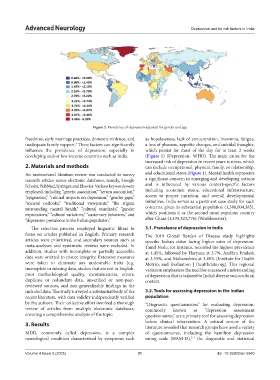
                                         Figure 2. Prevalence of depression adjusted for gender and age

            freedoms, early marriage practices, domestic violence, and   as hopelessness, lack of concentration, insomnia, fatigue,
                                 4
            inadequate family support.  These factors can significantly   a loss of pleasure, appetite changes, and suicidal thoughts,
            influence the prevalence of depression, especially in   which persist for most of the day for at least 2  weeks
            developing and/or low-income countries such as India.  (Figure  1) (Depression-  WHO). The main cause for the
                                                               increased risk of depression in recent years is stress, which
            2. Materials and methods                           can include occupational, physical, family, or relationship,

            An unstructured literature review was conducted to survey   and educational stress (Figure 1). Mental health represents
            research articles across electronic databases, namely, Google   a significant concern in emerging and developing nations
            Scholar, PubMed, Springer, and Elsevier. Various keywords were   and is influenced by various context-specific factors
            employed, including “genetic association,” “serum association,”   including economic status, educational infrastructure,
            “epigenetics,” “cultural impacts on depression,” “gender gaps,”   access to proper nutrition, and overall developmental
            “societal outlooks,” “traditional viewpoints,” “the stigma   initiatives. India serves as a pertinent case study for such
            surrounding mental health,” “cultural standards,” “gender   concerns, given its substantial population (1,380,004,385),
            expectations,” “cultural variations,” “customary behaviors,” and   which positions it as the second most populous country
            “depression prevalence in the Indian population.”  after China (1,439,323,776) (Worldometer).
              The selection process employed linguistic filters to   3.1. Prevalence of depression in India
            focus on articles published in English. Primary research   The 2019 Global Burden  of Disease study highlights
            articles  were  prioritized,  and  secondary  sources  such  as   specific  Indian  states  facing  higher  rates  of  depression.
            meta-analyses and systematic reviews were excluded. In   Tamil Nadu, for instance, recorded the highest prevalence
            addition,  studies  with incomplete or  partially accessible   at 4.45%, followed by Haryana at 3.7%, Andhra Pradesh
            data were omitted to ensure integrity. Extensive measures   at 3.53%, and Maharashtra at 3.48% (Institute for Health
            were taken to eliminate any undesirable traits (e.g.   Metrics  and Evaluation |  (healthdata.org). This regional
            incomplete or missing data, studies that are not in English,   variation emphasizes the need for a nuanced understanding
            poor methodological quality, inconsistencies,  errors,   of depression that is tailored to India’s diverse sociocultural
            duplicate or redundant data, unverified or non-peer-  context.
            reviewed sources, and non-generalizable findings in the
            included data. The study surveyed a substantial body of the   3.2. Tools for assessing depression in the Indian
            recent literature, with data validity independently verified   population
            by the authors. Their collective effort involved a thorough   “Diagnostic questionnaires” for evaluating depression,
            review of articles from multiple electronic databases,   commonly  known  as  “depression  assessment
            ensuring a comprehensive analysis of the topic.    questionnaires,” are a primary tool for assessing depression
            3. Results                                         before  clinical  intervention.  A  critical  review  of  the
                                                               literature revealed that research groups have used a variety
            MDD, commonly called depression, is a complex      of  questionnaires,  including  the  hamilton  depression
            neurological condition characterized by symptoms such   rating scale (HAM-D),  the diagnostic and statistical
                                                                                  5-9

            Volume 4 Issue 3 (2025)                         31                               doi: 10.36922/an.5940

