


Page 99 - AN-4-4
P. 99
Advanced Neurology                                                Diffusion model for brain tumor classification


            Softmaxx()   expi x                      (VII)       propagation, Adagrad, Adadelta, Adam, Adamax, and
                     i
                          k
                           ej x                                  Nadam, with Adam ultimately selected for its balance
                            j 1
                                                                  of computational efficiency and strong performance.
              Hyperparameter optimization was conducted to     (v)  Dropout regularization: Both convolution and fully
            fine-tune learning rates, batch sizes, and the number of   connected layers were regularized using dropout
            epochs. The Adam optimizer was used with a learning   regularization with a dropout rate of 25%.
            rate of 0.0001. The selection of hyperparameters in deep   (vi) Loss function: The loss used was categorical cross-
            deterministic decision-making models and CDDCNN is    entropy to check whether the predicted probability
            briefly described below.                              matches the true class output; hence, it enables the loss
            (i)  Learning rate: Learning rate was tested at values of   to compare itself with the one-hot encoded labels and
               0.0001, 0.001, 0.01, 0.1, and 0.2, with the optimal   also makes the loss a multi-class classification.
               learning rate of 0.0001 determined for CDCNN.
            (ii)  Batch size: Batch size is the number of samples that are   An 80/20 split was applied to the dataset for training and
               processed before any weight update, and was tested at   testing. The model was trained for 50 epochs with a batch
               10–100; the optimal batch size was 32.          size of 32. The integration of synthetic datasets from DDM
            (iii) Epochs number: This is the number of times that the   significantly enhanced the performance metrics, ensuring
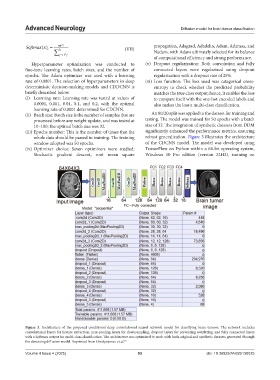
               whole data should be passed in training. The training   robust generalization. Figure 3 illustrates the architecture
               window adopted was 50 epochs.                   of the CDCNN model. The model was developed using
            (iv)  Optimizer choice: Seven optimizers were studied:   TensorFlow on Python within a 64-bit operating system,
               Stochastic gradient descent, root mean square   Windows 10 Pro edition (version  22H2), running on


            Figure  3. Architecture of the proposed conditional deep convolutional neural network model for classifying brain tumors. The network includes
            convolutional layers for feature extraction, max-pooling layers for downsampling, dropout layers for preventing overfitting, and fully connected layers
            with a Softmax output for multi-class classification. The architecture was optimized to work with both original and synthetic datasets generated through
            the denoising diffusion model. Reprinted from Onakpojeruo et al. 52

            Volume 4 Issue 4 (2025)                         93                           doi: 10.36922/AN025130025

