


Page 27 - ARNM-1-1
P. 27
Advances in Radiotherapy
            & Nuclear Medicine                                        Mathematic modeling of PDD for FF and FFF in photon


                         d                                     A
              PDD  =          e ·  − µ d                (I)
                  b-t
                        d + n
                         2
              PDD  (the abbreviation of PDD buildup-tail ) is described
                  b-t
            separately as buildup function and tail function in the
            following:
            (i).  Buildup function:   d  , where d is the depth in
                                d + n
                                 2
               water along the central axis in unit cm, n is a unitless
               beam hardening factor scalar.
            (ii). Tail function: e , where d is the depth in water along
                           -μd
               the central axis in unit cm, μ is a linear attenuation   B
               coefficient factor in unit cm  for adjusting the slope
                                      -1
                                                     -μd
               of  the  tail.  The  tail  function  in  the  form  of e   was
               composed of an exponential function with main
               parameters of d and μ.
              The empirical function of PDD is the combination of
            these two functions, denoted as PDD .
                                         b-t
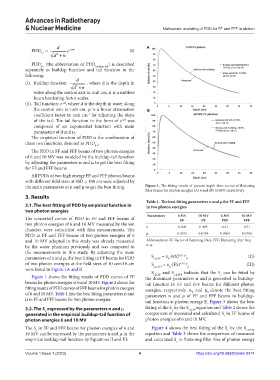
              The PDD in FF and FFF beams of two photon energies
            of 6 and 10 MV was modeled by the buildup-tail function
            by adjusting the parameters n and μ to get the best fitting
            for FF and FFF beams.
              All PDDs of two high energy FF and FFF photon beams
            with different field sizes at SSD = 100 cm were adjusted by
            the main parameters of n and μ to get the best fitting.  Figure 1. The fitting results of percent depth dose curves of flattening
                                                               filter beams for photon energies (A) 6 and (B) 10 MV, respectively.
            3. Results
                                                               Table 1. The best fitting parameters n and μ for FF and FFF
            3.1. The best fitting of PDD by empirical function in   in two photon energies
            two photon energies
                                                                Parameters   6 MV    10 MV     6 MV     10 MV
            The converted curves of PDD in FF and FFF beams of                FF       FF      FFF       FFF
            two photon energies of 6 and 10 MV measured by the ion   n       0.208    0.495    0.21      0.51
            chamber were coincident with film measurements. The
            PDD in FF and FFF beams of two photon energies of 6   μ         0.0515   0.0458    0.0565   0.0498
            and 10 MV adopted in this study was already measured   Abbreviations: FF: Factor of flattening filter; FFF: Flattening filter free;
            by the water phantom previously and was compared to   n: μ.
            the measurements in this study. By adjusting the main
                                                                             0.63 μ
            parameters of n and μ, the best fitting in FF beams for PDD   S c,E,FF  = n ·(FS)    E         (II)
                                                                         E
            of two photon energies at the field sizes of 10 cm×10 cm   S   = n ·(FS)                      (III)
                                                                              4.45 μ
                                                                         E
                                                                                 E
            were listed in Figure 1A and B.                      S c,E,FFF  and S   indicate that the S  can be fitted by
                                                                  c,E,FF
                                                                           c,E,FFF
                                                                                               c
              Figure 1 shows the fitting results of PDD curves of FF   the dominant parameters n and μ generated in buildup-
            beams for photon energies of 6 and 10 MV. Figure 2 shows the   tail function in FF and FFF beams for different photon
            fitting results of PDD curves of FFF beams for photon energies   energies, respectively. n  and  μ denote the best fitting
                                                                                   E
                                                                                         E
            of 6 and 10 MV. Table 1 lists the best fitting parameters n and   parameters n and  μ of FF and FFF beams in buildup-
            μ in FF and FFF beams for two photon energies.     tail function at photon energy E. Figure 3 shows the best
            3.2. The S  expressed by the parameters n and μ    fitting of the S  by the S c,E,FF  equation and Table 2 shows the
                                                                          c
                    c
            generated in the empirical buildup-tail function of   comparison of measured and calculated S  in FF beams of
                                                                                                c
            photon energies 6 and 10 MV                        photon energies of 6 and 10 MV.
            The S  in FF and FFF beams for photon energies of 6 and   Figure 4 shows the best fitting of the S  by the S c,E,FFF
                                                                                                  c
                c
            10 MV can be expressed by the parameters n and μ in the   equation and Table 3 shows the comparison of measured
            empirical buildup-tail function by Equations II and III:  and calculated S  in flattening filter free of photon energy
                                                                            c
            Volume 1 Issue 1 (2023)                         4                       https://doi.org/10.36922/arnm.0314

