


Page 48 - ARNM-2-2
P. 48
Advances in Radiotherapy
            & Nuclear Medicine                                              PET and Compton Camera CZT based system


            and activity of radiotherapeutic agents within the patient.   in its early stages regarding the efficacy of various PSMA-
            However, this leads to non-idealities in positron emission   PET imaging techniques for proper prognosis, PSMA-RLT
            tomography (PET) imaging as the need for non-pure   remains costly, and the limited supply of  Lu and  Ac
                                                                                                         225
                                                                                                 177
            positron (β ) emitters (positron emitting nuclides with   further complicates the situation. However, solving these
                     +
            additional gamma emissions) can cause image degradation   challenges would not only reduce costs but also prevent
            due to additional gamma emissions overlapping with the   unnecessary procedures  and  limit  radiation  exposure  to
            511 keV annihilation photon energy windows. In addition,   patients. 12,13
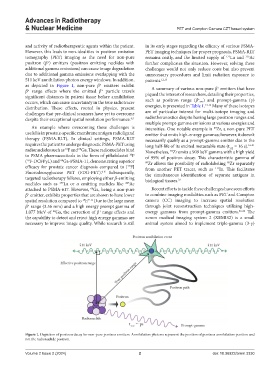
            as depicted in  Figure  1, non-pure  β  emitters exhibit   A summary of various non-pure β  emitters that have
                                           +
                                                                                             +
            β  range effects where the emitted  β  particle travels
             +
                                            +
            significant distances in patient tissue before annihilation   piqued the interest of researchers, detailing their properties,
                                                                                     +
            occurs, which can cause uncertainty in the true radiotracer   such as positron range (β ave) and prompt-gamma (γ)
                                                                                        14-16
            distribution. These effects, rooted in physics, present   energies, is presented in Table 1.   Many of these isotopes
            challenges that pre-clinical scanners have yet to overcome   are of particular interest for multi-isotope imaging and
            despite their exceptional spatial resolution performance. 4,5  radiotheranostics despite having large positron ranges and
                                                               multiple prompt-gamma emissions at various energies and
              An  example  where  overcoming  these  challenges is   intensities. One notable example is  Zr, a non-pure PET
                                                                                            89
            useful is in prostate-specific membrane antigen radioligand   emitter that emits high-energy gammas; however, it doesn’t
            therapy (PSMA-RLT). In clinical settings, PSMA-RLT   necessarily qualify as a prompt-gamma emitter due to the
            requires the patient to undergo diagnostic PSMA-PET using   long half-life of its excited metastable state (t  = 16 s). 16-21
                                                                                                   1/2
            radionuclides such as  F and  Ga. These radionuclides bind   Nonetheless,  Zremits a 909 keV gamma with a high yield
                             18
                                  68
                                                                         89

            to PSMA pharmaceuticals in the form of piflufolastat  F   of 99% of positron decay. This characteristic gamma of
                                                        18
            ( F-DCFPyL) and  Ga-PSMA-11, demonstrating superior   89 Zr allows the possibility of radiolabeling  Zr separately
                           68
            18
                                                                                                  89
            efficacy for prostate cancer diagnosis compared to [ F]   from  another  PET  tracer,  such  as   111 In.  This  facilitates
                                                       18
            Fluorodeoxyglucose PET (FDG-PET).  Subsequently,   the  simultaneous  identification of  separate antigens in
                                            6-8
            targeted radiotherapy follows, employing either β-emitting   biological tissues. 22
            nuclides  such as   177 Lu or  α emitting nuclides  like   225 Ac
            attached to PSMA-617. However,  Ga, being a non-pure   Recent efforts to tackle these challenges have seen efforts
                                        68
            β  emitter, exhibits properties that are shown to have lower   to combine imaging modalities such as PET and Compton
             +
            spatial resolution compared to  F. 9-11  Due to the large mean   camera (CC) imaging to increase spatial resolution
                                    18
            β  range (3.56 mm) and a high energy prompt gamma of   through joint reconstruction techniques utilizing high-
             +
            1.077 MeV of  Ga, the correction of β  range effects and   energy gammas from prompt-gamma emitters. 23-26  The
                        68
                                           +
            the capability to detect and reject high energy gammas are   xenon medical imaging system 2 (XEMIS2) is a small
            necessary to improve image quality. While research is still   animal system aimed to implement triple-gamma (3-γ)


            Figure 1. Depiction of positron decay for non-pure positron emitters. Annihilation photons represent the position of positron annihilation position and
            not the radionuclide position.


            Volume 2 Issue 2 (2024)                         2                              doi: 10.36922/arnm.3330

