


Page 52 - ARNM-2-2
P. 52
Advances in Radiotherapy
            & Nuclear Medicine                                              PET and Compton Camera CZT based system


            Γ. The FWHM is therefore equal to 2Γ while the FWTM is   around  511  keV. This  would  explain the distribution  of
            computed as  2Γ  9.                                photoelectric absorption below the Compton shelf of the
                                                               511 keV photons at 340 keV, where the cross-section of
            3. Results                                         photoelectric absorption is significantly higher for CZT.

            3.1. Sensitivity                                   3.2. Image reconstruction and comparison
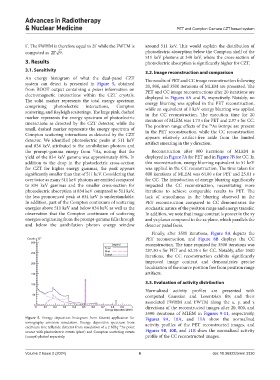
            An  energy  histogram  of  what  the  dual-panel  CZT   The results of PET and CC image reconstruction following
            system can detect is presented in  Figure  5,  obtained   20, 800, and 3500 iterations of MLEM are presented. The
            from ROOT output containing  a priori information on   PET and CC image reconstructions after 20 iterations are
            electromagnetic  interactions  within  the  CZT  crystals.   displayed in Figures 6A and B, respectively. Notably, no
            The solid marker represents the total energy spectrum   energy blurring was applied in the PET reconstruction,
            comprising  photoelectric  interactions,  Compton  while an equivalent of 1 keV energy blurring was applied
            scattering, and Rayleigh scatterings. The large pink, dashed   in  the  CC reconstruction. The  execution  time  for 20
            marker represents the energy spectrum of photoelectric   iterations of MLEM was 1.73 s for PET and 2.97 s for CC.
            interactions as  detected  by the  CZT  detector,  while  the   The positron range effects of the  As isotope are present
                                                                                          72
            small, dashed marker represents the energy spectrum of   in the PET reconstruction, while the CC reconstruction
            Compton scattering interactions as detected by the CZT   appears relatively artifact-free aside from the limited
            detector. We identified photoelectric peaks at 511 keV   artifact smearing in the y direction.
            and 834 keV, attributed to the annihilation photons and
            the prompt-gamma energy from  As, noting that the    Reconstruction after 800 iterations of MLEM is
                                         72
            yield of the 834 keV gamma was approximately 81%. In   displayed in Figure 7A for PET and in Figure 7B for CC. In
            addition to the drop in the photoelectric cross-section   this reconstruction, energy blurring equivalent to 51 keV
            for CZT for higher energy gammas, the peak appears   was applied in the CC reconstruction. The time taken for
            significantly smaller than that of 511 keV. Considering that   800 iterations of MLEM was 64.00 s for PET and 25.81 s
            over twice as many 511 keV photons are emitted compared   for CC. The introduction of energy blurring significantly
            to 834 keV gammas and the smaller cross-section for   impacted the CC reconstruction, necessitating more
            photoelectric absorption at 834 keV compared to 511 keV,   iterations to achieve comparable results to PET. The
            the less pronounced peak at 834 keV is understandable.   lack of smoothness in the blurring observed in the
            In addition, part of the Compton continuum of scattering   PET  reconstruction compared to  CC demonstrates  the
            energies above 511 keV and below 834 keV, as well as the   stochastic nature of the positron range and energy transfer.
            observation that the Compton continuum of scattering   In addition, we note that image contrast is poorer in the xy
            energies originating from the prompt-gamma falls through   and yz planes compared to the xz plane, which parallels the
            and  below  the  annihilation photon  energy window   detector panel faces.
                                                                 Finally, after 3500 iterations,  Figure  8A  depicts the
                                                               PET reconstruction,  and  Figure  8B  displays the CC
                                                               reconstruction. The time required for 3500 iterations was
                                                               287.30 s for PET and 62.76 s for CC. Notably, after 3500
                                                               iterations, the CC reconstruction exhibits significantly
                                                               improved image contrast and demonstrates precise
                                                               localization of the source position free from positron range
                                                               artifacts.
                                                               3.3. Evaluation of activity distribution
                                                               Normalized activity profiles are presented with
                                                               computed Gaussian and Lorentzian fits and their
                                                               associated FWHM and FWTM along the x, y, and z
                                                               directions of the reconstructed images after 20, 800, and
                                                               3500  iterations of MLEM in  Figures  9-11,  respectively.
            Figure  5.  Energy deposition histogram from Geant4 application for   Figures  9A,  10A,  and  11A show the normalized
            tomography emission simulation. Energy deposition spectrum from   activity profiles of the PET reconstructed images, and
            cadmium zinc telluride detector from simulation of a 2 MBq  As point
                                                    72
            source with photoelectric events (phot) and Compton scattering events   Figures  9B,  10B, and  11B show the normalized activity
            (compt) plotted separately.                        profile of the CC reconstructed images.


            Volume 2 Issue 2 (2024)                         6                              doi: 10.36922/arnm.3330

