


Page 50 - ARNM-2-2
P. 50
Advances in Radiotherapy
            & Nuclear Medicine                                              PET and Compton Camera CZT based system


            detectors by implementing a single-layer CZT design to   atomic number (Z), atomic weight (A), ionic charge (Q),
            capture  scattering and  absorption  interactions. This is   and excitation energy (E). This configuration enables the
            made possible by our detectors’ ability to resolve multiple   simulation of radioactive decay and atomic de-excitation
            photon interaction events (MIPEs) in the cross-strip design   physics, enabling the emission of positrons and their
            of CZT crystals, in which algorithms have been developed   kinematics, as well as positron annihilation. In addition, all
            to pair separately, detected intra-crystal scattered MIPE.    electromagnetic interaction physics involving annihilation
                                                         31
            Thus, simplifying the problem of implementing a separate   photons and prompt gammas with the CZT detector
            or combined imaging modality of PET and CC in software   crystals are specified using the em_standard_opt4 physics
            components. Users can then select between separate PET   list provided in GATE.
            mode, CC mode, or joint PET-CC mode based on the     In this study, we simulated  As with an activity of
                                                                                         72
            application–whether standard PET, multi-isotope, or triple   2 MBq over a 1 s acquisition time. The visualization of the
            gamma  coincidence  imaging. These  findings  build  upon   experiment in GATE is depicted in Figure 4. The source,
            previous work that quantified increases in sensitivity of   represented as a 0.1  mm radius sphere, is positioned
            similar single-layer CZT detector systems for dual PET-CC   centrally to the panels at the origin of a Cartesian coordinate
            imaging purposes,  making a significant advancement as   space (x, y, z) specified at (0, 0, 0). To demonstrate positron
                           45
            no CC reconstruction had been provided until this point.  range  and radiotracer  behavior in  soft-tissue equivalent

            2. Methods                                         material, the source was placed centrally within a spherical
                                                               water phantom of 2 cm diameter.
            The study utilized Monte Carlo simulation of the dual-panel
            CZT PET detector imaging system, employing the well-  2.3. Image reconstruction
            established Geant4 application for tomography emission   We performed PET image reconstruction utilizing an
            (GATE) software. 46,47  The simulated isotope,  As, with its   in-house list-mode maximum likelihood expectation
                                                72
            large positron range (5.19 mm), enables comparison of PET   maximization (LM-MLEM) iterative reconstruction
            and CC reconstruction methods. Furthermore, its prompt-  code, implemented in the compute unified device
            gamma emission (834 keV at 81%) allows us to demonstrate   architecture (CUDA) software. This method follows the
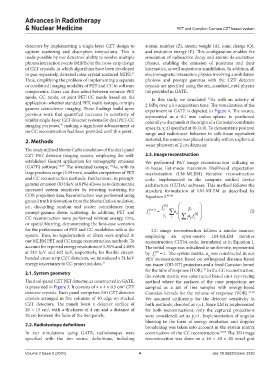
            increased system sensitivity by detecting scattering for   standard formulation of LM-MLEM as described by
            COR projection data. Reconstruction was performed using   Equation I. 48,49
            ground truth information from the Monte Carlo simulation,
            i.e., discarding random and scatter coincidences from     f j  k      p
            prompt-gamma  down scattering. In  addition, PET  and   f j  k ( 1 )    s   a ij   i  k    (I)
                                                                                 af
            CC reconstruction were performed without energy, time,     j  i      j ij  j
            or spatial blurring, demonstrating the best-case scenarios
            for the performance of PET and CC modalities within the   CC image reconstruction follows a similar manner,
            system. Thus, no regularization or filters were applied in   employing  an  open-source  LM-MLEM  iterative
            our MLEM PET and CC image reconstruction methods. To   reconstruction CUDA code, formulated as in Equation I.
            account for reported energy resolutions of 5.85% and 4.40%   The initial image was initialized to uniformity, represented
            at 511 keV and 622 keV, respectively, for flexible circuit-  by  f  ()0  = 1 . The system matrix, a  was constructed in our
                                                                   j
                                                                                          ij
            bonded cross-strip CZT detectors, we introduced a 51 keV   PET reconstruction based on orthogonal distance-based
            energy uncertainty to CC projection data. 41       ray-tracer (OD-RT) projectors and a fixed Gaussian kernel
                                                               for the tube of response (TOR).  In the CC reconstruction,
                                                                                       50
            2.1. System geometry
                                                               the system matrix was constructed based on a ray-tracing
            The dual-panel CZT PET detector, as constructed in GATE,   method where the surfaces of the cone projections are
            is presented in Figure 3. It consists of 4 × 4 × 0.5 cm  CZT   sampled as a set of line samples with energy-based
                                                     3
            detector crystals. Each panel comprises 150 CZT detector   Gaussian kernels for the volume of response (VOR). 51,52
            crystals arranged in five columns of 30 edge-on stacked   We assumed uniformity for the detector sensitivity in
            CZT detectors. The panels boast a detector surface of   both methods, denoted as s =1. Since LM is implemented
                                                                                     j
            20 × 15 cm , with a thickness of 4 cm and a distance of   for both reconstructions, only the captured projections
                     2
            20 cm between the faces of the two panels.         were considered, set as p =1. Implementation of angular
                                                                                    i
                                                               blurring  in  the  form  of energy  resolution  and  doppler
            2.2. Radioisotope definitions                      broadening was taken into account in the system matrix
            In our simulations using GATE, radioisotopes were   construction of the CC reconstruction. 53,54  The 3D image
            specified with the ion source definitions, including   reconstruction was done on a 40 × 40 × 40 voxel grid


            Volume 2 Issue 2 (2024)                         4                              doi: 10.36922/arnm.3330

