


Page 49 - ARNM-2-2
P. 49
Advances in Radiotherapy
            & Nuclear Medicine                                              PET and Compton Camera CZT based system


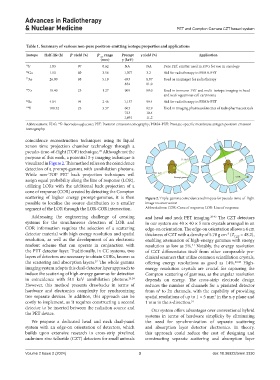
            Table 1. Summary of various non‑pure positron‑emitting isotope properties and applications
            Isotope  Half‑life (h)  β  yield (%)  β +   range   Prompt   γ yield (%)  Application
                                +
                                            ave
                                            (mm)     γ (keV)
            18 F          1.83    97         0.62        NA         NA  Pure PET emitter used in FDG for use in oncology
            68 Ga         1.13    89         3.56     1,077         3.2  Aid for radiotherapy in PSMA-PET
            72 As         26.00   88         5.19        693   8.07    Used as an imager for radiotherapy
                                                         834   81.0
            89 Zr         18.40   23         1.27        909   99.0    Used in immuno-PET and multi-isotope imaging in head
                                                                       and neck squamous cell carcinoma
            44 Sc         4.04    94         2.46     1,157    99.4    Aid for radiotherapy in PSMA-PET
            124 I     100.32      23         3.37        603   62.9    Used in imaging pharmacokinetics of radiopharmaceuticals
                                                         723   10.4
                                                      1,691    11.2
            Abbreviations: FDG:  F-fluorodeoxyglucose; PET: Positron emission tomography; PSMA-PET: Prostate-specific membrane antigen positron emission
                          18
            tomography.
            coincidence  reconstruction  techniques  using  its  liquid
            xenon time projection chamber technology through a
            pseudo-time-of-flight (TOF) technique.  Although not the
                                           25
            purpose of this work, a potential 3-γ imaging technique is
            visualized in Figure 2. This method relies on the coincidence
            detection of a prompt-gamma with annihilation photons.
            While non-TOF PET back projection techniques will
            assign equal probability along the line of response (LOR),
            utilizing LORs with the additional back projection of a
            cone of response (COR) created by detecting the Compton
            scattering of higher energy prompt-gammas, it is then   Figure 2. Triple-gamma coincidence techniques for pseudo-time-of-flight
            possible to localize the source distribution to a smaller   image reconstruction
            segment of the LOR through the LOR-COR intersection.  Abbreviations: COR: Cone of response; LOR: Line of response.
              Addressing the engineering challenge of creating   and head and neck PET imaging. 28-42  The CZT detectors
            systems  for  the  simultaneous  detection  of  LOR  and   in our system are 40 × 40 × 5 mm crystals arranged in an
            COR information requires the selection of a scattering   edge-on orientation. The edge-on orientation allows a 4 cm
            detector material with high energy resolution and spatial   thickness of CZT with a density of 5.78 g cm  (Z   = 48.2),
                                                                                                 -3
                                                                                                     CZT
            resolution, as well as the development of an electronic   enabling attenuation of high-energy gammas with energy
            readout scheme that can operate in conjunction with   resolution as low as 5%.  Notably, the energy resolution
                                                                                   41
            the PET detector layer. Traditionally, in CC systems, two   of CZT differentiates itself from other comparable pre-
            layers of detectors are necessary to obtain CORs, known as   clinical scanners that utilize common scintillation crystals,
            the scattering and absorption layers.  The whole gamma   offering energy resolutions as good as 14%. 43,44  High-
                                         27
            imaging system adopts this dual-detector layer approach to   energy resolution crystals are crucial for capturing the
            induce the scattering of high-energy gammas for detection   Compton scattering of gammas, as the angular resolution
            in coincidence with 511 keV annihilation photons. 23,24    depends on energy. The cross-strip electrode design
            However, this method presents drawbacks in terms of   reduces the number of channels for a pixelated detector
            hardware and electronics complexity for synchronizing   from n  to 2n channels, with the capability of providing
                                                                     2
            two separate devices. In addition, this approach can be   spatial resolutions of up to 1 × 5 mm  in the x-y plane and
                                                                                            2
            costly to implement, as it requires constructing a second   1 mm in the z-direction. 31
            detector to be inserted between the radiation source and   Our system offers advantages over conventional hybrid
            the PET device.
                                                               systems  in terms of hardware simplicity by eliminating
              We propose a dedicated head and neck dual-panel   the need for synchronization of separate scattering
            system with an edge-on orientation of detectors, which   and absorption layer detector electronics. In theory,
            builds upon extensive research in cross-strip pixelized   this approach could reduce the cost of designing and
            cadmium zinc telluride (CZT) detectors for small animals   constructing separate scattering and absorption layer


            Volume 2 Issue 2 (2024)                         3                              doi: 10.36922/arnm.3330

