


Page 55 - ARNM-2-2
P. 55
Advances in Radiotherapy
            & Nuclear Medicine                                              PET and Compton Camera CZT based system


            A


            B


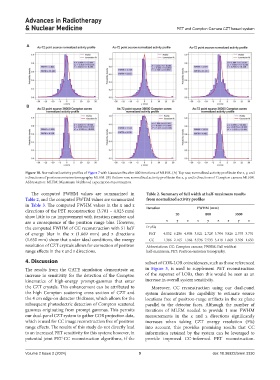
            Figure 10. Normalized activity profiles of Figure 7 with Gaussian fits after 800 iterations of MLEM. (A) Top row, normalized activity profiles in the x, y, and
            z directions of positron emission tomography MLEM. (B) Bottom row, normalized activity profiles in the x, y, and z directions of Compton camera MLEM.
            Abbreviation: MLEM: Maximum likelihood expectation maximization.

              The computed FWHM values are summarized in       Table 2. Summary of full width at half‑maximum results
            Table 2, and the computed FWTM values are summarized   from normalized activity profiles
            in Table 3. The computed FWHM values in the x and z   Iteration          FWHM (mm)
            directions of the PET reconstruction (3.701 – 4.025 mm)
            show little to no improvement with iteration number and         20          800          3500
            are a consequence of the positron range blur. However,      x   y    z   x   y    z   x   y    z
            the computed FWHM of CC reconstruction with 51 keV   Profile
            of energy blur in the x  (1.669  mm) and z directions   PET  4.052 6.286 4.008 3.821 2.728 3.704 3.826 2.379 3.701
            (1.650 mm) show that under ideal conditions, the energy   CC  1.386 2.165 1.368 3.536 7.533 3.418 1.669 3.509 1.650
            resolution of CZT crystals allows for correction of positron   Abbreviations: CC: Compton camera; FWHM: Full width at
            range effects in the x and z directions.           half-maximum; PET: Positron emission tomography.
            4. Discussion                                      subset of COR-LOR coincidences, such as those referenced

            The results from the GATE simulation demonstrate an   in  Figure  3, is used to supplement PET reconstruction
            increase in sensitivity for the detection of the Compton   of the superset of LORs, then this would be seen as an
            kinematics of high-energy prompt-gammas that enter   increase in overall system sensitivity.
            the CZT crystals. This enhancement can be attributed to   Moreover,  CC  reconstruction  using  our  dual-panel
            the high Compton scattering cross section of CZT and   system demonstrates the capability to estimate source
            the 4 cm edge-on detector thickness, which allows for the   locations free of positron-range artifacts in the xz plane
            subsequent photoelectric detection of Compton scattered   parallel to the detector faces. Although the number of
            gammas originating from prompt gammas. This permits   iterations of MLEM needed to provide 1  mm FWHM
            our dual-panel CZT system to gather COR projection data,   measurements in the x and z directions significantly
            which is used for CC image reconstruction free of positron   increases when taking CZT energy resolution (5%)
            range effects. The results of this study do not directly lead   into account, this provides promising results that CC
            to an increased PET sensitivity for this system; however, in   information retained by the system can be leveraged to
            potential joint PET-CC reconstruction algorithms, if the   provide improved CC-informed PET reconstruction.


            Volume 2 Issue 2 (2024)                         9                              doi: 10.36922/arnm.3330

