


Page 56 - ARNM-2-2
P. 56
Advances in Radiotherapy
            & Nuclear Medicine                                              PET and Compton Camera CZT based system


            A


            B


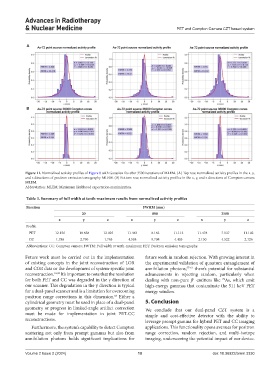
            Figure 11. Normalized activity profiles of Figure 8 with Gaussian fits after 3500 iterations of MLEM. (A) Top row, normalized activity profiles in the x, y,
            and z directions of positron emission tomography MLEM. (B) Bottom row, normalized activity profiles in the x, y, and z directions of Compton camera
            MLEM.
            Abbreviation: MLEM: Maximum likelihood expectation maximization.

            Table 3. Summary of full width at tenth‑maximum results from normalized activity profiles
            Iteration                                         FWHM (mm)
                                    20                            800                          3500
                          x         y          z         x         y        z          x        y         z
            Profile
             PET        12.156     18.858    12.025    11.463    8.183     11.113    11.478    7.137     11.102
             CC          1.786     2.790     1.763      4.558    9.708     4.405     2.150     4.522     2.126
            Abbreviations: CC: Compton camera; FWTM: Full width at tenth-maximum; PET: Positron emission tomography.

            Future work must be carried out in the implementation   future work in random rejection. With growing interest in
            of existing concepts in the joint reconstruction of LOR   the experimental validation of quantum entanglement of
            and COR data or the development of system-specific joint   annihilation photons, 57-61  there’s potential for substantial
            reconstruction. 16,25  It’s important to note that the resolution   advancements in rejecting random, particularly when
            for both PET and CC was degraded in the y direction of   dealing with non-pure  β  emitters like  As, which emit
                                                                                                72
                                                                                   +
            our scanner. This degradation in the y direction is typical   high-energy gammas that contaminate the 511 keV PET
            for a dual-panel scanner and is a limitation for overcoming   energy window.
            positron range corrections in this dimension.  Either a
                                                  56
            cylindrical geometry must be used in place of a dual-panel   5. Conclusion
            geometry or progress in limited-angle artifact correction   We conclude that our dual-panel CZT system is a
            must  be  made  for  implementation  in  joint  PET-CC   simple and cost-effective detector with the ability to
            reconstructions.                                   leverage prompt gamma for hybrid PET and CC imaging
              Furthermore, the system’s capability to detect Compton   applications. This functionality opens avenues for positron
            scattering not only from prompt gammas but also from   range  correction,  random  rejection,  and  multi-isotope
            annihilation photons holds significant implications for   imaging, underscoring the potential impact of our device.


            Volume 2 Issue 2 (2024)                         10                             doi: 10.36922/arnm.3330

