


Page 57 - ARNM-3-1
P. 57
Advances in Radiotherapy
            & Nuclear Medicine                                                   The novel index and osteoradionecrosis


            3. Results                                         divide  the  patients  into  two  groups  with  significantly
                                                               different rates of ORNJ. This resulted in the following
            A retrospective review of the medical records of   groups: PIV < 833 (n = 154) and PIV ≥ 833 (n = 66), as well
            220 patients with LA-NPC treated at our institution was   as TE < 4 (n = 127) and TE ≥ 4 (n = 93). When comparing
            conducted. The median age was 56 (range, 18 – 76) years,   the PIV and TE groups, ORNJ rates were significantly
            and 151 (68.6%) patients were male. Among the patients,   higher in the PIV ≥ 833 and TE ≥ 4 groups compared to
            55.5% and 75.5% had a history of alcohol consumption   their PIV<833 and TE<4 counterparts, respectively (2.6%
            and tobacco smoking, respectively. Most patients had T3   vs. 25.8% for PIV ≥ 833; P < 0.001 and 3.14% vs. 22.4% for
            – 4 (67.3%) or N2 – 3 (80%) disease stage. Before starting   TE ≥ 4; P < 0.001).
            C-CRT, all patients underwent at least one TE, with a
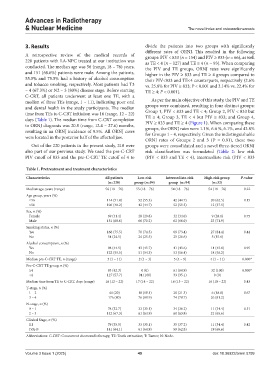
            median of three TEs (range, 1 – 11), indicating poor oral   As per the main objective of this study, the PIV and TE
            and dental health in the study participants. The median   groups were combined, resulting in four distinct groups:
            time from TEs to C-CRT initiation was 16 (range, 12 – 22)   Group 1, PIV < 833 and TE < 4; Group 2, PIV < 833 but
            days  (Table 1). The median time from C-CRT completion   TE ≥ 4; Group 3, TE < 4 but PIV ≥ 833; and Group 4,
            to ORNJ diagnosis was 20.8 (range, 12.4 – 27.6) months,   PIV ≥ 833 and TE ≥ 4 (Figure 1). When comparing these
                                                               groups, the ORNJ rates were 1.1%, 6.6 %, 6.1%, and 43.8%
            resulting in an ORNJ incidence of 9.5%. All ORNJ cases
            were located in the posterior half of the affected jaw.  for Groups 1 – 4, respectively. Given the indistinguishable
                                                               ORNJ rates of  Groups  2 and 3 (P  = 0.91), these  two
              Out of the 220 patients in the present study, 210 were   groups were consolidated and a novel three-tiered ORNJ
            also part of our previous study. We used the pre-C-CRT   risk classification was formulated (Table  2: low risk
            PIV cutoff of 833 and the pre-C-CRT TE cutoff of 4 to   (PIV < 833 and TE < 4), intermediate risk (PIV < 833

            Table 1. Pretreatment and treatment characteristics
            Characteristics                   All patients   Low‑risk   Intermediate‑risk   High‑risk group   P‑value
                                               (n=220)    group (n=94)   group  (n=94)     (n=32)
            Median age, years (range)         56 (18 – 76)  55 (18 – 76)  54 (18 – 76)    54 (18 – 76)   0.22
            Age group, years (%)
             ≤56                              114 (51.8)    52 (55.3)      42 (44.7)       20 (62.5)     0.15
             >56                              106 (48.2)    42 (44.7)      52 (55.3)       12 (37.5)
            Sex, n (%)
             Female                            69 (31.4)    28 (29.8)      32 (34.0)       9 (28.1)      0.75
             Male                             151 (68.6)    66 (70.2)      62 (66.0)       23 (71.9)
            Smoking status, n (%)
             Yes                              166 (75.5)    70 (74.5)      69 (73.4)       27 (84.4)     0.44
             No                                54 (24.5)    24 (25.5)      25 (26.6)       5 (15.6)
            Alcohol consumption, n (%)
             Yes                               98 (44.5)    43 (45.7)      41 (43.6)       14 (43.8)     0.95
             No                               122 (55.5)    51 (54.3)      53 (56.4)       18 (56.2)
            Median pre-C-CRT TE, n (range)     3 (1 – 11)   2 (1 – 3)      5 (4 – 9)      4 (1 – 11)    0.000*
            Pre-C-CRT TE group, n (%)
             ≥4                                93 (42.3)     0 (0)         61 (64.9)       32 (100)     0.000*
             <4                               127 (57.7)    94 (100)       33 (35.1)        0 (0)
            Median time from TE to C-CRT, days (range)  16 (12 – 22)  17 (14 – 22)  16 (13 – 22)  16 (10 – 22)  0.43
            T-stage, n (%)
             1 – 2                             44 (20)      18 (19.1)      20 (21.3)       6 (18.8)      0.67
             3 – 4                             176 (80)     76 (80.9)      74 (78.7)       26 (81.2)
            N-stage, n (%)
             0 – 1                             78 (32.7)    33 (35.1)      34 (36.2)       11 (34.4)     0.51
             2 – 3                            142 (67.3)    61 (64.9)      60 (63.8)       21 (65.6)
            Clinical Stage, n (%)
             III                               79 (35.9)    33 (35.1)      35 (37.2)       11 (34.4)     0.42
             IVA-B                            141 (64.1)    61 (64.9)      59 (62.8)       19 (65.6)
            Abbreviations: C-CRT: Concurrent chemoradiotherapy; TE: Tooth extraction; T: Tumor; N: Node.


            Volume 3 Issue 1 (2025)                         49                             doi: 10.36922/arnm.5799

