


Page 47 - ARNM-3-3
P. 47
Advances in Radiotherapy
            & Nuclear Medicine                                                PI3K and Akt in androgen-independent PCa


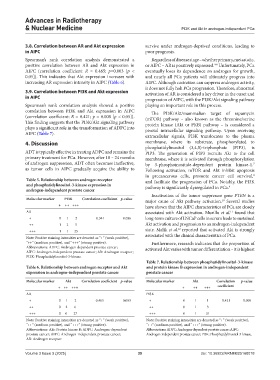
            3.8. Correlation between AR and Akt expression     survive under androgen-deprived conditions, leading to
            in AIPC                                            poor prognosis.
            Spearman’s  rank  correlation  analysis  demonstrated  a   Regardless of disease stage – whether primary, metastatic,
            positive correlation between AR and Akt expression in   or AIPC – AR is positively expressed.  Unfortunately, PCa
                                                                                            4-6
            AIPC  (correlation  coefficient:  R  =  0.465;  p=0.003  [p  <   eventually loses its dependence on androgen for growth,
            0.05]). This indicates that Akt expression increases with   and nearly all PCa patients will ultimately progress into
            increasing AR expression intensity in AIPC (Table 6).  AIPC. Although castration can suppress androgen activity,
                                                               it does not fully halt PCa progression. Therefore, abnormal
            3.9. Correlation between PI3K and Akt expression   activation of AR is considered a key driver in the onset and
            in AIPC                                            progression of AIPC, with the PI3K/Akt signaling pathway
            Spearman’s rank correlation analysis showed a positive   playing an important role in this process.
            correlation between PI3K and Akt expression in AIPC   The PI3K/Akt/mammalian target of rapamycin
            (correlation coefficient: R = 0.421; p = 0.008 [p < 0.05]).   (mTOR) pathway – also known as the threonine/serine
            This finding suggests that the PI3K/Akt signaling pathway   protein kinase (Akt or PKB) pathway – is considered a
            plays a significant role in the transformation of ADPC into   pivotal intracellular signaling pathway. Upon receiving
            AIPC (Table 7).
                                                               extracellular signals, PI3K translocates to the plasma
            4. Discussion                                      membrane, where its substrate, phosphorylated to
                                                               phosphatidylinositol (3,4,5)-triphosphate (PIP3), is
            ADT is typically effective in treating ADPC and remains the   PIP3. The generation of PIP3 recruits Akt to the cell
            primary treatment for PCa. However, after 18 – 24 months   membrane, where it is activated through phosphorylation
            of androgen suppression, ADT often becomes ineffective,   by 3-phosphoinositide-dependent protein kinase-1.
                                                                                                             7
            as tumor cells in AIPC gradually acquire the ability to   Following activation, mTOR and Akt inhibit apoptosis
                                                                                                             8
                                                               in precancerous cells, promote cancer cell survival,
            Table 5. Relationship between androgen receptor    and  facilitate the  progression  of PCa.  Notably,  the  PI3K
            and phosphatidylinositol‑3‑kinase expression in                                       9
            androgen‑independent prostate cancer               pathway is significantly dysregulated in PCa.
                                                                 Inactivation of the tumor suppressor gene  PTEN is a
            Molecular marker  PI3K  Correlation coefficient p‑value  major cause of Akt pathway activation.  Several studies
                                                                                               10
                          +  ++ +++                            have shown that the AIPC characteristics of PCa are closely
            AR                                                 associated with Akt activation. Murillo et al.  found that
                                                                                                   11
             +            0  1   2        0.341      0.036     long-term culture of LNCaP cells in serum leads to sustained
             ++           1  2   5                             Akt activation and progression to an androgen-independent
                                                                             12
             +++          1  1   25                            state. Malik et al.  reported that activated Akt is strongly
            Note: Positive staining intensities are denoted as “+” (weak positive),   associated with the clinical characteristics of PCa.
            “++” (medium positive), and “+++” (strong positive).  Furthermore, research indicates that the proportion of
            Abbreviations: ADPC: Androgen-dependent prostate cancer;   activated Akt varies with tumor differentiation – it is highest
            AIPC: Androgen-independent prostate cancer; AR: Androgen receptor;
            PI3K: Phosphatidylinositol-3-kinase.
                                                               Table 7. Relationship between phosphatidylinositol‑3‑kinase
            Table 6. Relationship between androgen receptor and Akt   and protein kinase B expression in androgen‑independent
            expression in androgen‑independent prostate cancer  prostate cancer
            Molecular marker  Akt   Correlation coefficient p‑value  Molecular marker  Akt   Correlation   p‑value
                          + ++ +++                                             +   ++   +++   coefficient
            AR                                                 PI3K
             +            0  1   2        0.465      0.003      +              0    1    1     0.421    0.008
             ++           0  2   6                              ++             0    1    3
             +++          0  0  27                              +++            0    1    31
            Note: Positive staining intensities are denoted as “+” (weak positive),   Note: Positive staining intensities are denoted as “+” (weak positive),
            “++” (medium positive), and “+++” (strong positive).  “++” (medium positive), and “+++” (strong positive).
            Abbreviations: Akt: Protein kinase B; ADPC: Androgen-dependent   Abbreviations: ADPC: Androgen-dependent prostate cancer; AIPC:
            prostate cancer; AIPC: Androgen-independent prostate cancer;    Androgen-independent prostate cancer; PI3K: Phosphatidylinositol-3-kinase.
            AR: Androgen receptor.


            Volume 3 Issue 3 (2025)                         39                        doi: 10.36922/ARNM025160018

