


Page 44 - ARNM-3-3
P. 44
Advances in Radiotherapy
            & Nuclear Medicine                                                PI3K and Akt in androgen-independent PCa


            intensity,” 2 for “brown granules and medium intensity,”   3. Results
            and 3 for “brown granules and strong intensity.”
                                                               3.1. Clinical features
              The final score was obtained by multiplying the
            percentage score by the staining intensity score and was   In the AIPC group, seven out of 38 patients (7/38) were
            interpreted as follows: a score of 0 was considered negative,   ≤60 years old, and 31 patients (31/38) were >60 years old,
            1 – 3 as weak positive (+), 4 – 7 as medium positive (++),   with a mean age of 66.26 ± 7.53 years. The mean PSA level
                                                               was 46.58 ng/mL: 21 patients (21/38) with PSA ≤ 20 ng/mL
            and 8 – 12 as strong positive (+++).
                                                               and 17 patients (17/38) with PSA > 20 ng/mL.
            2.4. Scoring and grouping                            In the ADPC group, four out of 38 patients (4/38) were
            The Gleason grading system was employed to evaluate all   ≤60 years old, and 34 patients (34/38) were >60 years old,
            needle biopsy specimens. Under double-blind conditions,   with a mean age of 73.21 ± 9.63 years. The mean PSA level
            two senior pathologists independently reviewed the cross-  was 72.40 ng/mL, in which nine patients (9/38) had PSA
            sectional slides and issued pathological reports. In cases   ≤ 20 ng/mL and 29 patients (29/38) had PSA > 20 ng/mL
            of discrepancies, a third senior pathologist reviewed the   (Table 1).
            findings and provided the final pathological diagnosis.  These findings suggest that the prognosis of the AIPC

              The Gleason score (GS) ranges from 2 to 10:  2 – 4   group may be worse than the ADPC group. There is a
            indicates high differentiation, 5 – 6 indicates moderate   significant difference (p < 0.01) observed between the groups
            differentiation, and 7 – 10 indicates low differentiation.   regarding PSA distribution (≤20 ng/mL vs. >20 ng/mL).
            Based on a comprehensive understanding of PCa      Furthermore, the GS in the AIPC group is significantly
            treatment and classification, the updated grading system   higher than the ADPC group (mean GS = 37.208; p < 0.01)
            (2015  version)  divides biopsies into five prognostic   (Table 1).
                        3
            grading groups according to glandular shape, integrity, and
            degree of fusion:                                  3.2. Histopathological features
            (i)  Grade  group  1:  GS ≤  6;  composed of  well-formed,   The GS in the AIPC group was generally high, with all
               individually separated glands.                  38 patients scoring above 7. Among them, 27 cases (27/38,
            (ii)  Grade group 2: GS 3 + 4 = 7; composed primarily of   71.1%) had a GS of 8 (grade group 4), including Gleason
               well-formed glands with a small number of cribriform   patterns 4  +  4, 3  + 5,  and  5 +  3 =  8.  In some  regions,
               or fused glands.                                cancerous tissue consisted of densely packed or cribriform
            (iii) Grade group  3: GS 4 + 3 = 7; composed mainly of   glands (Figure 1A), while other areas were predominantly
               cribriform and fused glands, with fewer well-formed   composed of poorly differentiated components lacking
               glands.
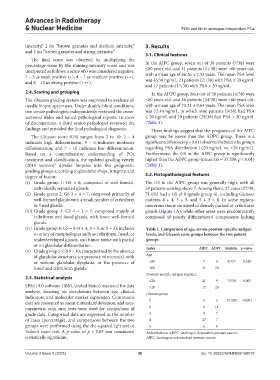
            (iv)  Grade group 4: GS = 8 (4 + 4, 3 + 5, or 5 + 3); includes   Table 1. Comparison of age, serum prostate‑specific antigen
               a variety of morphologies such as cribriform, fused, or   levels, and Gleason score groups between the two patient
               underdeveloped glands, and tumor tissue with partial   groups
               or no glandular differentiation.
            (v)  Grade group 5: GS 9 – 10; characterized by the absence   Index       AIPC ADPC Statistic p‑value
               of glandular structures (or presence of necrosis), with   Age
               or without glandular dysplasia, or the presence of   ≤60                7     4    0.957  0.328
               fused and cribriform glands.                     >60                    31   34
                                                               Prostate-specific antigen (ng/mL)
            2.5. Statistical analysis
                                                                ≤20                    21    9    7.930  0.005
            SPSS 19.0 software (IBM, United States) was used for data   >20            17   29
            analysis, focusing on correlations between age, clinical   Gleason group
            indicators, and molecular marker expression. Continuous
            data are presented as mean ± standard deviation, and non-  1               0     5   37.208  <0.001
            parametric rank sum tests were used for comparison of   2                  0    11
            grade data. Categorical data are expressed as the number   3               0     7
            of cases (percentage), and comparisons between the two   4                 27    7
            groups were performed using the chi-squared (χ ) test or   5               11    8
                                                   2
            Fisher’s exact test. A p-value of p < 0.05 was considered   Abbreviations: ADPC: Androgen-dependent prostate cancer;
            statistically significant.                         AIPC: Androgen-independent prostate cancer.


            Volume 3 Issue 3 (2025)                         36                        doi: 10.36922/ARNM025160018

