


Page 29 - BH-2-2
P. 29
Brain & Heart                                                  Predictive modeling using electroencephalogram


            relies on validation data to check how well various trained   BCILAB  and  EEGLAB,  which  are  MATLAB  toolboxes.
            models perform. Researchers are increasingly interested   The proposed systematic approach includes:
            in diving  into more complex and automated feature   (i)  Signal processing is the process of taking unprocessed
            extraction methods, suggesting that the field of feature   data and transforming it into a form that can be read
            extraction is reaching its point of diminishing returns. For   and utilized by other devices.
            certain biological signals, choosing the optimal feature   (ii)  Feature  extraction can  create  the necessary feature
            from extracted features may not always be straightforward   vectors from either embedded or continuous signals.
            since some features may not be equally informative, may   (iii) Training and test data are fed into a predictive model.
            lose some important information present in the raw data,   (iv)  The BCI paradigms standardize the full computational
                                             23
            or maybe noisy, correlated, or irrelevant.  To understand   approach, from data-driven model learning to offline
            how to represent the data and make complex EEG        data sets or real-time cognitive state prediction.
            oscillatory data useful for categorization, ML models were   (v)  It is possible to connect certain pieces of hardware to
            applied.                                              the BCILAB’s data-crunching infrastructure by means
                                                                  of online plug-ins and drivers.
            3. System model                                      Electrodes  are applied to the  scalp to  record  EEG

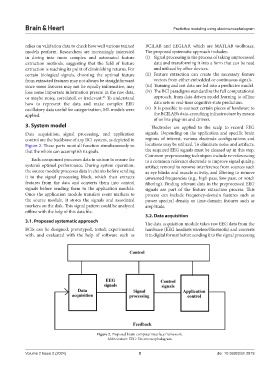
            Data acquisition, signal processing, and application   signals. Depending on the application and specific brain
            control are the backbone of any BCI system, as depicted in   regions of interest, various electrode configurations and
            Figure 2. These parts must all function simultaneously so   locations may be utilized. To eliminate noise and artifacts,
            that the whole can accomplish its goals.           the acquired EEG signals must be cleaned up in this step.
                                                               Common preprocessing techniques include re-referencing
              Each component processes data in unison to ensure the   to a common reference electrode to improve signal quality,
            system’s optimal performance. During system operation,   artifact removal to remove interference from sources such
            the source module processes data in chunks before sending   as eye blinks and muscle activity, and filtering to remove
            it to the signal processing block, which then extracts   unwanted frequencies (e.g., high-pass, low-pass, or notch
            features  from  the  data  and  converts  them  into control   filtering). Finding relevant data in the preprocessed EEG
            signals  before sending them to the application module.   signals are part of the feature extraction process. This
            Once the application module transfers event markers to   process can include frequency-domain features such as
            the  source  module, it  stores  the  signals  and associated   power spectral density or time-domain features such as
            markers on the disk. This signal pattern could be analyzed   amplitude.
            offline with the help of this data file.
                                                               3.2. Data acquisition
            3.1. Proposed systematic approach
                                                               The data acquisition module takes raw EEG data from the
            BCIs can be designed, prototyped, tested, experimented   hardware (EEG headsets wireless/Bluetooth) and converts
            with, and evaluated with the help of software such as   it to digital format before sending it to the signal processing


                                          Figure 2. Proposed brain-computer interface framework.
                                               Abbreviation: EEG: Electroencephalogram.


            Volume 2 Issue 2 (2024)                         5                                doi: 10.36922/bh.2819

