


Page 32 - BH-2-2
P. 32
Brain & Heart                                                  Predictive modeling using electroencephalogram


            limited or interpretability is important. Choosing the   Table 2. K‑size analysis
            best model requires careful consideration of the features
            of the dataset, the computational limitations, and the   Subject  Components  k=1  k=4  k=7  k=9  k=11
            requirements for interpretability so that the model selected   Subject 1  Band power  47.8  54.7  58.2  60.2  62.5
            closely matches the particular requirements of the EEG     Average     34.5  42.8  44.6  50.3  52.4
            signal processing task.                                    RMS          65   68.4  72.3  76.2  70
              The BCI IV Competition-I dataset may not be entirely   Subject 2  Band power  46.2  48.4  49  51.2  54.6
            representative of  the general population  despite offering   Average  48.8  46.6  44.1  45.4  50
            insightful information on the processing and classification   RMS       52   53.3  56.7  54.4  60.2
            of EEG signals. Thus, to evaluate the generalizability   Subject 3  Band power  64.6  62.9  61  60.1  58.2
            and performance of models trained on such benchmark        Average     55.2  50   52.2  52.5  59.1
            datasets in real-world applications, comprehensive
            evaluation and validation, including cross-validation and   RMS         62   67.2  70.2  68.3  65
            testing on independent datasets, are necessary. Careful   Abbreviation: RMS: Root-mean square.
            validation is required to determine the best classification
            technique with better parameters. The k-fold cross-  Table 3. Principal component analysis functions analysis
            validation strategy is best because it employs all of the   Subject  Components  Linear  Kernel  RBF kernel
            data trails for both training and testing, which is especially
            important given the small sample size. It is possible that   Subject 1  Band power  65.2  65.2  63.1
            using different techniques will result in an insufficiently   Average     42.3    42.3     42.5
            precise validation error. When there are many variables in   RMS          68.1    72.6     70.4
            the ML method, model selection can be critical. The best   Subject 2  Band power  52.1  52.1  48
            model can be selected by tweaking individual features in    Average       42      42       46.7
            isolation. However, the accuracy of classification when     RMS           64      64       62.2
            employing different models may differ from one individual   Subject 3  Band power  51  51  48.4
            to the next and from one data set to the next. Using
            solely MATLAB’s built-in ML and statistics toolboxes,       Average       56.3    56.3     47.4
            we conducted the following analysis. All feature vectors    RMS           72.2    72.2     74.6
            were utilized during both the training and testing phases,   Abbreviations: RBF: Radial basis function; RMS: Root-mean square.
            employing k-fold cross-validation techniques.
            4.2.1. K-nearest neighbors
            Table 2 demonstrates that a well-trained classifier for the
            sorts of signals utilized is often produced using the KNN
            method to the dataset and extracting features with different
            k-values.
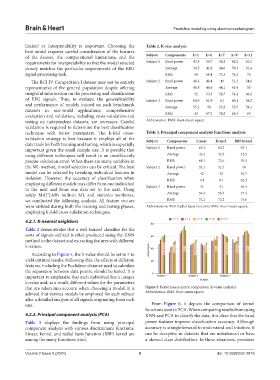
              According to Figure 5, the k-value should be set to 7 to
            yield optimal results. Following this, the effects of different
            features, including the Euclidean distance used to calculate
            the separation between data points, should be tested. It is
            important to emphasize that each individual has a unique
            k-value and, as a result, different values for the parameters
            that are taken into account when choosing a model. It is   Figure 5. Performance metric comparison (k-value analysis).
            advised that various models be employed for each subject   Abbreviation: RMS: Root-mean square.
            after a detailed analysis of all signals originating from each
            one.                                                 From  Figure  6, it depicts the comparison of kernel
                                                               functions used in PCA. When comparing results from using
            4.2.2. Principal component analysis (PCA)          KNN and PCA to classify the data, it is clear that the band
            Table 3 displays the findings from using principal   power features improve classification accuracy. Although
            component analysis with various discriminant functions.   accuracy is straightforward to understand and intuitive, it
            Linear, kernel, and radial basis function (RBF) kernel are   can be deceptive in datasets that are unbalanced or have
            among the many functions tried.                    a skewed class distribution. In these situations, precision


            Volume 2 Issue 2 (2024)                         8                                doi: 10.36922/bh.2819

