


Page 35 - BH-2-2
P. 35
Brain & Heart                                                  Predictive modeling using electroencephalogram


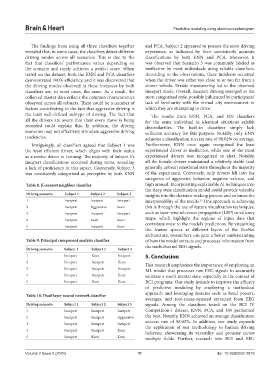
              The findings from using all three classifiers together   and PCA. Subject 2 appeared to possess the most driving
            revealed that, in some cases, the classifiers detect different   experience, as indicated by their consistently accurate
            driving modes across all scenarios. This is due to the   classifications by both KNN and PCA. Moreover, it
            fact that  classifiers’  performance varies  depending on   was observed that Scenario 3 was commonly labeled as
            the scenario and rarely achieves a perfect score. When   ineffective by most individuals using reliable classifiers.
            tested on the dataset, both the KNN and PCA classifiers   According to the observations, these incidents occurred
            demonstrated 100% efficiency, and it was discovered that   when the driver was either too close to or too far from a
            the driving modes observed in these instances by both   slower vehicle. Erratic maneuvering led to the observed
            classifiers are, in most cases, the same. As a result, the   inexpert mode. Overall, inexpert driving emerged as the
            collected master data reflects the common characteristics   most categorized style, possibly influenced by participants’
            observed across all subjects. There could be a number of   lack of familiarity with the virtual city environment in
            factors contributing to the fact that aggressive driving is   which they are attempting to drive.
            the least well-defined subtype of driving. The fact that   The results from KNN, PCA, and NN classifiers
            all the drivers are aware that their every move is being   for the same individual in identical situations exhibit
            recorded could explain this. In addition, the driving   dissimilarities. The built-in classifiers simply lack
            scenarios may not effectively stimulate aggressive driving   sufficient accuracy for this  purpose. Notably, only KNN
            tendencies.                                        achieves a classification success rate of 98.02% on average.
              Intriguingly, all classifiers agreed that Subject 1 was   Furthermore, KNN  once  again  recognized  the  least
            the least efficient driver, which aligns with their status   experienced driver as ineffective, while one of the most
            as a novice driver in training. The majority of Subject 1’s   experienced drivers was recognized as alert. Notably,
            inexpert classifications occurred during turns, revealing   all the female drivers maintained a relatively stable (and
            a lack of proficiency in this aspect. Conversely, Subject 3   generally upbeat) emotional state throughout the majority
            was consistently categorized as perceptive by both KNN   of the experiment. Conversely, only drivers fell into the
                                                               categories of  aggressive  behavior,  negative  valence,  and
            Table 8. K‑nearest neighbor classifier             high arousal. Incorporating explainable AI techniques into
                                                               the sleep state classification model could provide valuable
            Driving scenario  Subject 1  Subject 2  Subject 3  insights into the decision-making process and enhance the
            1                Inexpert   Inexpert   Inexpert    interpretability of the results.  One approach to achieving
                                                                                      15
            2                Inexpert   Aggressive  Keen       this is through the use of feature visualization techniques,
            3                Inexpert   Inexpert   Inexpert    such as layer-wise relevance propagation (LRP) or saliency
            4                Inexpert   Keen       Keen        maps, which highlight the regions of input data that
            5                Inexpert   Inexpert   Keen        contribute most to the model’s predictions. By visualizing
                                                               the feature spaces at different layers of the ResNet
                                                               architecture, researchers can gain a better understanding
            Table 9. Principal component analysis classifier   of how the model extracts and processes information from
                                                               the multichannel EEG signals.
            Driving scenario  Subject 1  Subject 2  Subject 3
            1               Inexpert    Keen       Inexpert    5. Conclusion
            2               Inexpert    Inexpert   Keen        This research emphasizes the importance of employing an
            3               Inexpert    Inexpert   Inexpert    ML model that processes raw EEG signals to accurately
            4               Inexpert    Inexpert   Keen        estimate a user’s mental state, especially in the context of
            5               Inexpert    Keen       Keen        BCI programs. Our study intends to improve the efficacy
                                                               of predictive  modeling  by  employing  a methodical
                                                               approach and leveraging features such as band powers,
            Table 10. Dual‑layer neural network classifier
                                                               averages, and root-mean-squared extracted from EEG
            Driving scenario  Subject 1  Subject 2  Subject 3  signals. Among the classifiers tested on the BCI IV
            1               Inexpert    Inexpert   Inexpert    Competition-I dataset, KNN, PCA, and NN performed
            2               Inexpert    Inexpert   Aggressive  the best. Notably, KNN achieved an average classification
            3               Inexpert    Inexpert   Inexpert    success rate of 98.02%. In addition, our study expands
                                                               the  application  of  our  methodology  to  human  driving
            4               Inexpert    Inexpert   Keen        behavior, showcasing its versatility and promise across
            5               Inexpert    Keen       Keen        multiple fields. Further, research into BCI and EEG


            Volume 2 Issue 2 (2024)                         11                               doi: 10.36922/bh.2819

