


Page 34 - BH-2-2
P. 34
Brain & Heart                                                  Predictive modeling using electroencephalogram


            characteristics and will make full use of its dynamics when
            dealing with the behavior of a keen subject while operating
            the vehicle. Cars can be maneuvered with lightning speed
            and pinpoint accuracy. Any unintended responses are
            promptly adjusted. Attitudes of aggression have been
            linked to stimuli with a high arousal value but a negative
            valence. An aggressive operator is one who takes great
            risks in pursuit of his goals and is known for using forceful
            methods to achieve them. An inexperienced person’s
            emotional  state  is  low  arousal  and  negative  valence,
            characterized by fatigue and boredom. This causes drivers
            to veer off course, speed up and slow down unexpectedly,
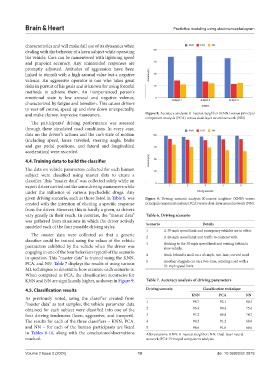
            and make clumsy, imprecise maneuvers.              Figure 8. Accuracy analysis: K-nearest neighbor (KNN) versus principal
                                                               component analysis (PCA) versus dual-layer neural network (NN).
              The participants’ driving performance was assessed
            through  these  simulated  road  conditions.  In  every  case,
            data on the driver’’s actions and the car’s state of motion
            (including  speed, lanes  traveled,  steering  angle, brake
            and gas pedal positions, and lateral and longitudinal
            acceleration) were recorded.
            4.4. Training data to build the classifier
            The data on vehicle parameters collected for each human
            subject were  classified using master  data  to  create  a
            classifier. This “master data” was collected solely while an
            expert driver carried out the same driving maneuvers while
            under the influence of various psychedelic drugs. Any
            given driving scenario, such as those listed in Table 6, was   Figure  9.  Driving scenario analysis: K-nearest neighbor (KNN) versus
            created with the intention of eliciting a specific response   principal component analysis (PCA) versus dual-layer neural network (NN).
            from the driver. However, this is hardly a given, as drivers
            vary greatly in their reach. In contrast, the “master data”   Table 6. Driving scenario
            was gathered from situations in which the driver actively
            modeled each of the four possible driving styles.  Scenario                Details
                                                               1       A 35-mph speed limit and emergency vehicles are in effect.
              The master data were collected so that a generic   2     A 40-mph speed limit and traffic to contend with.
            classifier could be trained using the values of the vehicle
            parameters exhibited by the vehicle when the driver was   3  Sticking to the 30-mph speed limit and waiting behind a
                                                                       slow vehicle.
            engaging in one of the four behaviors typical of the scenario   4  Stuck behind a snail on a 45-mph, two-lane, curved road
            in question. This “master data” is trained using the KNN,
            PCA, and NN. Table 7 displays the results of using various   5  Another sluggish car on a two-lane, winding road with a
                                                                       50-mph speed limit.
            ML techniques to determine how accurate each scenario is.
            When compared to PCA, the classification accuracies for
            KNN and NN are significantly higher, as shown in Figure 9.  Table 7. Accuracy analysis of driving parameters
            4.5. Classification results                        Driving scenario        Classification technique
                                                                                  KNN         PCA         NN
            As previously noted, using the classifier created from
            “master data” as test samples, the vehicle parameter data   1          98.7        92.1       80.3
            obtained for each subject were classified into one of the   2          96.4        90.4       75.6
            four driving tendencies (keen, aggressive, and inexpert).   3          97.2        89.8       74.7
            The results for each of the three classifiers – KNN, PCA,   4          99.2        91.2       68.8
            and NN – for each of the human participants are listed   5             98.6        91.6       66.6
            in  Tables  8-10, along with the conclusions/observations   Abbreviations: KNN: K-nearest neighbor; NN: Dual-layer neural
            reached.                                           network; PCA: Principal component analysis.


            Volume 2 Issue 2 (2024)                         10                               doi: 10.36922/bh.2819

