


Page 33 - BH-2-2
P. 33
Brain & Heart                                                  Predictive modeling using electroencephalogram


            and recall offer more information about the performance
            of the classifier but might not be as effective at capturing
            the overall classification performance as accuracy. The
            aforementioned tabulated results demonstrate that it
            would be unrealistic to assume that a single classification
            model would be effective across multiple datasets obtained
            from multiple  test subjects under  multiple  experimental
            conditions and over time. The algorithm may not be able
            to accurately fit the available data into the model, or a lack
            of training data may be to blame for some models’ low
            performance for some subjects.

            4.2.3. Neural networks
                                                               Figure 6. Performance metric comparison: Function analysis.
            Through the process of learning a representation of the   Abbreviations: RBF: Radial basis function; RMS: Root-mean square.
            input at the hidden layers, multilayer neural networks
            can be utilized for feature learning before being applied to
            classification or regression. The majority of neural networks
            will adjust the model’s parameters iteratively in response to
            a training sample. With each iteration, the cost function,
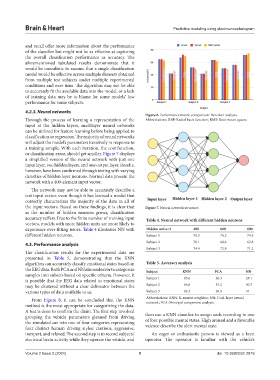
            or classification error, should get smaller. Figure 7 displays
            a  simplified version of the neural network with just one
            input layer, two hidden layers, and one output layer. Results,
            however, have been confirmed through testing with varying
            densities of hidden layer neurons. Normal data present the
            network with a 400-element input vector.
              The network may not be able to accurately describe a
            test input vector, even though it has learned a model that
            correctly characterizes the majority of the data in all of
            the input vectors. Based on these findings, it is clear that   Figure 7. Neural network structure.
            as  the  number  of  hidden  neurons  grows,  classification
            accuracy suffers. Due to the finite number of training input   Table 4. Neural network with different hidden neurons
            vectors, models with more hidden units are more likely to
            experience over-fitting issues. Table 4 illustrates NN with   Hidden units=2  400  600        800
            different hidden neurons.                          Subject 1           78.3        76.2       74.5
            4.3. Performance analysis                          Subject 2           70.1        68.6       62.8
                                                               Subject 3           74.4        72.9       71.2
            The  classification  results  for  the  experimental  data  are
            presented in  Table 5, demonstrating that the KNN
            algorithm can accurately classify emotional states based on   Table 5. Accuracy analysis
            the EEG data. Both PCA and NN also endeavor to categorize   Subject  KNN        PCA           NN
            samples into subsets based on specific criteria. However, it
            is possible that the EEG data related to emotional states   Subject 1  85.6      36.3         28.1
            may be clustered without a clear delineator between the   Subject 2  86.8        34.2         30.3
            various types of data available to us.             Subject 3       82.3          28.8         31
              From  Figure  8, it can be concluded that the KNN   Abbreviations: KNN: K-nearest neighbor; NN: Dual-layer neural
                                                               network; PCA: Principal component analysis.
            method is the most appropriate for categorizing the data.
            A test is done to confirm the claim. The first step involved
            grouping  the  vehicle  parameters  gleaned from  driving   then use a KNN classifier to assign each recording to one
            the simulated car into one of four categories representing   of four possible mental states. High arousal and a favorable
            four distinct human driving styles: cautious, aggressive,   valence describe the alert mental state.
            inexpert, and relaxed. The second step is to record subjects’   An eager or enthusiastic person is viewed as a keen
            electrical brain activity while they operate the vehicle, and   operator. The operator is familiar with the vehicle’s


            Volume 2 Issue 2 (2024)                         9                                doi: 10.36922/bh.2819

