


Page 31 - BH-2-2
P. 31
Brain & Heart                                                  Predictive modeling using electroencephalogram


            movements of their left or right hand, foot, or tongue
            in  response  to  randomized  cues.  The  sequence  of  the
            indicators was random. This experiment comprised
            multiple runs of 60 trials each. Each trial began with an
            auditory  stimulus presented  at  t  = 5  s,  followed  by  the
            appearance of a cross “+” on the screen, which remained
            visible throughout the trial. At t = 10 s, participants were
            shown an arrow pointing left, right, up, or down for 2 s,
            during which they were instructed to imagine moving their
            left hand, right hand, tongue, or feet. Finally, at t = 12 s, the
            cross  vanished. This  experimental  paradigm formed the
            basis for in-house data acquisition trials conducted with
            the Emotiv EEG headset.
              The stimulus presentation software included with
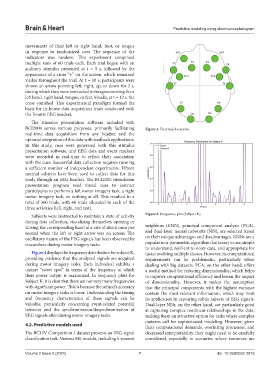
            BCI2000 serves various purposes, primarily facilitating   Figure 3. Electrode locations.
            real-time data acquisition from any headset and the
            optional integration of this data with feedback applications.
            In this study, cues were generated with this stimulus
            presentation software, and EEG data and event markers
            were recorded in real-time to reflect their association
            with the cues. Successful data collection requires running
            a sufficient number of independent experiments. Fifteen
            normal subjects have been used to collect data for this
            study through an EEG headset. The BCI2000 stimulation
            presentation program used visual cues to instruct
            participants to perform a left motor imagery task, a right
            motor imagery task, or nothing at all. This resulted in a
            total of 360 trials, with 60 trials allocated to each of the
            three activities (left, right, and rest).
              Subjects were instructed to maintain a state of activity   Figure 4. Frequency plot (Subject K).
            during data collection, visualizing themselves opening or
            closing the corresponding hand at a rate of about once per   neighbors (KNN), principal component analysis (PCA),
            second when the left or right arrow was on screen. The   and dual-layer neural networks (NN), are selected based
            oscillatory nature of the EEG signals has been observed by   on their unique advantages and disadvantages. KNNs are a
            researchers during motor imagery tasks.            popular non-parametric algorithm that is easy to use, simple
                                                               to understand, resilient to noisy data, and appropriate for
              Figure 4 displays the frequency distribution for subject K,   tasks involving multiple classes. However, its computational
            providing evidence that the analyzed signals are acquired   requirements can be problematic, particularly when
            during motor imagery tasks. Each individual exhibits a   dealing with big datasets. PCA, on the other hand, offers
            unique “sweet spot” in terms of the frequency at which   a useful method for reducing dimensionality, which helps
            their power output is maximized. In frequency plots for   to improve computational efficiency and lessen the impact
            Subject K, it is clear that there are not very many frequencies   of dimensionality. However, it makes the assumption
            with significant power. This is because the subject’s accuracy   that the principal components with the highest variance
            on motor imagery tasks is lower. Understanding the timing   contain the most relevant information, which may limit
            and frequency characteristics of these signals can be   its application in capturing subtle aspects of EEG signals.
            valuable, particularly concerning event-related potential   Dual-layer NNs, on the other hand, are particularly good
            latencies and the synchronization/desynchronization of   at capturing complex nonlinear relationships in the data,
            EEG signals after/during motor imagery tasks.      making them an attractive option for tasks where complex
                                                               patterns call for sophisticated modeling. However, given
            4.2. Predictive models used                        their computational demands, overfitting proneness, and
            The BCI IV Competition-I dataset presents an EEG signal   decreased interpretability, they might need to be carefully
            classification task. Various ML models, including k-nearest   considered, especially in scenarios where resources are


            Volume 2 Issue 2 (2024)                         7                                doi: 10.36922/bh.2819

