


Page 47 - DP-2-1
P. 47
Design+                                                             Legitimizing design thinking in companies


            in the workplace. The results indicated that Team Beta   opposed to random noise. The leadership characteristics
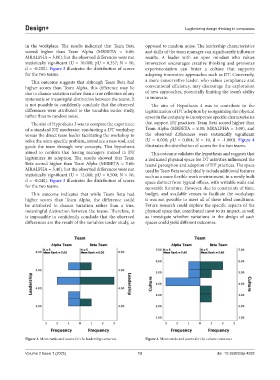
            scored higher than Team Alpha  (MRBETA = 6.00;     and skills of the team manager can significantly influence
            MRALPHA = 5.00), but the observed differences were not   results. A  leader with an open mindset who values
            statistically significant (U = 10.000; pU = 0.357; N = 10,   innovation  encourages  creative  thinking  and  promotes
            d = -0.200). Figure 2 illustrates the distribution of scores   experimentation can foster a culture that supports
            for the two teams.                                 adopting innovative approaches such as DT. Conversely,
              This outcome suggests that although Team Beta had   a more conservative leader, who values compliance and
            higher scores than Team Alpha, this difference may be   conventional efficiency, may discourage the exploration
            due to chance variation rather than a true reflection of any   of new approaches, potentially limiting the team’s ability
            systematic or meaningful distinction between the teams. It   to innovate.
            is not possible to confidently conclude that the observed   The aim of Hypothesis 4 was to contribute to the
            differences  were  attributed  to  the  variables  under  study,   legitimization of DT adoption by reorganizing the physical
            rather than to random noise.                       space in the company to incorporate specific characteristics
              The aim of Hypothesis 3 was to compare the experience   that support DT practices. Team Beta scored higher than
            of a standard DT moderator conducting a DT workshop   Team Alpha (MRBETA = 8.00; MRALPHA = 3.00), and
            versus the direct team leader facilitating the workshop to   the observed differences were statistically significant
            solve the team-specific problem, introduce a new tool, and   (U = 0.000; pU = 0.004;  N = 10, d =  -1.000).  Figure  4
            guide the team through new concepts. This hypothesis   illustrates the distribution of scores for the two teams.
            aimed to confirm that having managers trained in DT   This outcome validates the hypothesis and suggests that
            legitimizes its adoption. The results showed that Team   a dedicated physical space for DT activities influenced the
            Beta scored higher than Team Alpha (MRBETA = 5.60;   teams’ perception and adoption of DT practices. The space
            MRALPHA = 5.40), but the observed differences were not   used by Team Beta would ideally include additional features
            statistically significant (U = 12.000; pU = 0.500; N = 10,   such as a more flexible work environment, in a newly built
            d = -0.040). Figure 3 illustrates the distribution of scores   space distinct from typical offices, with writable walls and
            for the two teams.                                 moveable furniture. However, due to constraints of time,
              This outcome indicates that while Team Beta had   budget, and available venues to facilitate the workshop,
            higher scores than Team Alpha, the difference could   it was not possible to meet all of these ideal conditions.
            be attributed to chance variation rather than a true,   Future research could explore the specific aspects of the
            meaningful distinction between the teams. Therefore, it   physical space that contributed most to its impact, as well
            is impossible to confidently conclude that the observed   as investigate whether variations in the design of such
            differences are the result of the variables under study, as   spaces could yield different outcomes.


            Figure 2. Mean ranks and scores for the leadership construct  Figure 3. Mean ranks and scores for the culture construct


            Volume 2 Issue 1 (2025)                         13                               doi: 10.36922/dp.4292

