


Page 45 - DP-2-1
P. 45
Design+                                                             Legitimizing design thinking in companies


            surged, with earnings increasing by 40% annually from   flexibility should extend beyond just interior areas.  A
                                                                                                          41
            1996 to 2001, while maintaining the same personnel size.   total of four items were used, on a Likert-type scale where
            Since the relocation, its average yearly return has been   1 corresponds to “not suitable at all” and 5 corresponds to
            28%. A workplace design that aligns with the company’s   “very suitable.”
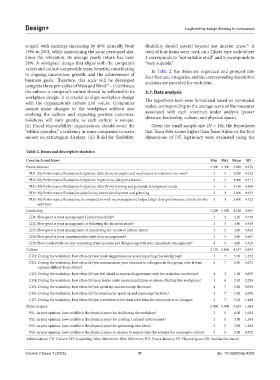
            values and culture can provide many benefits, contributing   In Table 2, the items are organized and grouped into
            to  ongoing  innovation,  growth,  and  the  achievement  of   four thematic categories, and the corresponding descriptive
            business goals. Therefore, this scale will be developed   statistics are provided for each item.
            using the three principles of West and Wind  – (i) embrace
                                              41
            the culture: a company’s culture should be reflected in its   3.7. Data analysis
            workplace design. It is crucial to align workplace design   The hypothesis tests were formulated based on summated
            with the  organization’s  culture and  values. Companies
            cannot  make  changes  to  the  workplace  without  also   scales, corresponding to the average score of the measures
            evolving the culture and expecting positive outcomes.   associated with each construct under analysis (power
            Solutions will vary greatly, as each culture is unique.   distance, leadership, culture, and physical space).
            (ii) Fiscal responsibility: organizations should avoid the   Given the small sample size (N = 10), the hypotheses
            “edifice complex,” a tendency in some companies to waste   that Team Beta scores higher than Team Alpha on the four
            money on extravagant displays. (iii) Build for flexibility:   dimensions of DT legitimacy were evaluated using the


            Table 2. Items and descriptive statistics
            Constructs and items                                                           Min  Max  Mean  SD
            Power distance                                                                3.400 4.400  3.880  0.270
             PD1: My Performance Evaluation helped me identify my strengths and weaknesses in relation to my work.  4  5  4.200  0.422
             PD2: My Performance Evaluation helped me improve my job performance.           3   5   4.000  0.471
             PD3: My Performance Evaluation helped me identify my training and personal development needs.  3  5  4.100  0.568
             PD4: My Performance Evaluation aided in my career development and planning.    2   4   3.300  0.675
             PD5:  My Performance Evaluation, in conjunction with my management, helped align clear performance criteria for the   3  4  3.800  0.422
                 next year.
            Leadership                                                                    3.200 5.000  4.100  0.655
             LD1: How good is your management’s leadership ability?                         3   5    4.10  0.738
             LD2: How good is your management at following the decisions made?              2   5    3.80  0.919
             LD3: How good is your management at monitoring the results of actions taken?   3   5    4.00  0.816
             LD4: How good is your communication with your management?                      3   5    4.00  0.667
             LD5: How comfortable are you expressing your opinions and disagreeing with your immediate management?  4  5  4.60  0.516
            Culture                                                                       2.710 5.860  4.557  0.953
             CU1: During the workshop, how often did you make suggestions on issues impacting this workgroup?  3  7  5.70  1.252
             CU2:  During the workshop, how often did you communicate your opinions to colleagues in this group, even if your   5  7  6.30  0.675
                 opinion differed from others?
             CU3: During the workshop, how often did you feel afraid to express disagreement with the workshop moderator?   1  3  1.30  0.675
             CU4: During the workshop, how often did team leader make recommendations on issues affecting this workgroup?  1  6  3.10  2.234
             CU5: During the workshop, how often did you speak up and encourage the team?   4   7    5.20  0.919
             CU6: During the workshop, how often did the team leader speak up and encourage the team?  1  7  5.20  2.098
             CU7: During the workshop, how often did you contribute to the team with ideas for new projects or changes?  3  7  5.10  1.449
            Physical space                                                                2.000 5.000  3.625  1.069
             PS1: In your opinion, how suitable is the physical space for facilitating the workshop?  2  5  4.00  1.054
             PS2: In your opinion, how suitable is the physical space for creating a relaxed environment?  2  5  3.50  1.354
             PS3: In your opinion, how suitable is the physical space for generating new ideas?  2  5  3.50  1.269
             PS4: In your opinion, how suitable is the physical space in relation to aspects that characterize the company's culture?   2  5  3.50  0.972
            Abbreviations: CU: Culture; LD: Leadership; Max: Maximum; Min: Minimum; PD: Power distance; PS: Physical space; SD: Standard deviation.


            Volume 2 Issue 1 (2025)                         11                               doi: 10.36922/dp.4292

