


Page 48 - DP-2-1
P. 48
Design+                                                             Legitimizing design thinking in companies


                                                               was not possible to confidently conclude that the observed
                                                               differences were attributable to the variables under study,
                                                               as opposed to random variation. Although no statistically
                                                               significant differences were found between Team Alpha
                                                               and Team Beta across several hypotheses, Hypothesis 1
                                                               suggests  that  both  teams  demonstrate  similar  levels  of
                                                               confidence in creativity, which may indicate that they both
                                                               recognize the importance of creativity within their work
                                                               context. As such, this finding suggests that both teams
                                                               are open to exploring creative approaches, even if the
                                                               differences have not been statistically validated.
                                                                 Regarding Hypothesis 2, the results indicated that Team
                                                               Beta had higher scores than Team Alpha; however, it was
                                                               not possible to confidently conclude that the observed
                                                               differences were due to the studied variables rather than
                                                               random variation. Although no statistically significant
                                                               difference was found in the culture of openness and
                                                               feedback between the two teams, this finding emphasizes
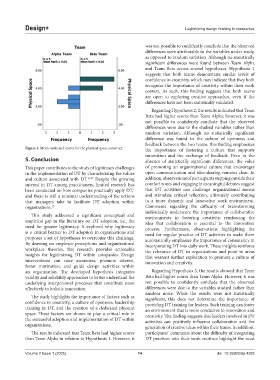
            Figure 4. Mean ranks and scores for the physical space construct  the importance of fostering a culture that supports
                                                               innovation and the exchange of feedback. Even in the
            5. Conclusion                                      absence of statistically significant differences, the value

            This paper contributes to the study of legitimacy challenges   of promoting an organizational culture that encourages
            in the implementation of DT by characterizing the values   open communication and idea-sharing remains clear. In
            and culture associated with DT. 16,37  Despite the growing   addition, observations of participants stepping outside their
            interest in DT among practitioners, limited research has   comfort zones and engaging in meaningful debates suggest
            been conducted on how companies practically apply DT,    that DT activities can challenge organizational norms
                                                          1
            and there is still a minimal understanding of the actions   and  stimulate  critical  reflection,  ultimately  contributing
            that managers take to facilitate DT adoption within   to a more dynamic and innovative work environment.
            organizations. 13                                  Comments regarding the difficulty of brainstorming
                                                               individually underscore the importance of collaborative
              This study addressed a significant conceptual and   environments  in  fostering  creativity,  reinforcing  the
            empirical  gap  in  the  literature  on  DT  adoption,  i.e.,  the   idea that collaboration is essential to the innovation
            need for greater legitimacy. It explored why legitimacy   process. Furthermore, observations highlighting the
            is a critical barrier to DT adoption in organizations and   need for regular practice of DT activities to make them
            proposes a set of hypotheses to overcome this challenge.   automatically emphasize the importance of consistency in
            By drawing on employee perceptions and organizational   incorporating DT into daily work. These insights reinforce
            workplace theories, this research provides actionable   the relevance of DT in organizations and point to areas
            insights for legitimizing  DT within  companies.  Design   that warrant further exploration to promote a culture of
            interventions can raise awareness, promote interest,   innovation and creativity.
            foster motivation, and guide design activities within
            an organization. The developed hypothesis integrates   Regarding Hypothesis 3, the results showed that Team
            validity and reliability approaches to better understand the   Beta had higher scores than Team Alpha. However, it was
            underlying interpersonal processes that contribute most   not possible to confidently conclude that the observed
            effectively to holistic innovation.                differences were due to the variables studied rather than
                                                               random noise. While the results were not statistically
              The study highlights the importance of factors such as   significant, this does not determine the importance of
            confidence in creativity, a culture of openness, leadership   providing DT training for leaders. Such training can foster
            training in DT, and the creation of a dedicated physical   an environment that is more conducive to innovation and
            space. These factors are shown to play a critical role in   creativity. The finding suggests that leaders involved in DT
            the successful adoption and implementation of DT within   activities can positively influence collaboration and the
            organizations.                                     generation of creative ideas within their teams. In addition,
              The results indicated that Team Beta had higher scores   participants’ comments about the difficulty of integrating
            than Team Alpha in relation to Hypothesis 1. However, it   DT practices into their work routines highlight the need


            Volume 2 Issue 1 (2025)                         14                               doi: 10.36922/dp.4292

