


Page 46 - DP-2-1
P. 46
Design+                                                             Legitimizing design thinking in companies


            Wilcoxon–Mann–Whitney non-parametric test for two   the day after the theoretical training, which may have
            independent samples.  Statistical analyses were performed   provided greater continuity and a stronger connection
                             48
            using IBM SPSS Statistics software, version  28, with   between the concepts learned and their practical
            α = 0.05. As this software version of the software does not   application. This workshop timing allowed Team Alpha
            calculate the effect size for the Wilcoxon–Mann–Whitney   to maintain momentum and enthusiasm during the
            test, we manually computed the effect size using the   theoretical training, potentially enhancing their ability
            formula presented by Marôco. 49                    to adopt and implement DT more effectively. On the
                                                               other hand, Team Beta had a 2-week gap between the
            4. Results                                         theoretical training and the practical workshop, which
            Table  3 presents the results of the Wilcoxon–Mann–  may have led to a disconnect between theory and
            Whitney non-parametric test for all research hypotheses.   practice. This gap in time could have resulted in a loss
            According to the results, only the dimension of physical   of enthusiasm, interest, and even some forgetting of key
            space showed statistically significant differences between   concepts.
            the two teams. Although Team Beta’s scores were higher   The aim of Hypothesis 2 was to empower employees to
            than Team Alpha on all other dimensions, these differences   speak up and build trust, thereby increasing their focus on
            were not statistically significant.                work. This increase in productivity occurs when employees

              Hypothesis 1 aimed to promote closer relationships,   feel heard while expressing their opinions, which leads to a
            relaxation, increased bonding among team members,   decrease in negative attitudes and an increase in happiness
            more idea sharing in a more informal environment,
            stimulate adaptability in activities outside one’s comfort
            zone, and foster greater motivation and productivity
            among employees. The results showed that Team Beta
            scored higher than Team Alpha  (MRBETA = 5.70;
            MRALPHA = 5.30), but the observed differences are not
            statistically significant (U = 13.500; pU = 0.429; N = 10,
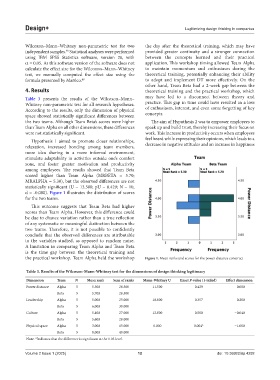
            d = -0.080). Figure 1 illustrates the distribution of scores
            for the two teams.
              This outcome suggests that Team Beta had higher
            scores than Team Alpha. However, this difference could
            be due to chance variation rather than a true reflection
            of any systematic or meaningful distinction between the
            two teams. Therefore, it is not possible to confidently
            conclude that the observed differences are attributable
            to the variables studied, as opposed to random noise.
            A limitation in comparing Team Alpha and Team Beta
            is the time gap between the theoretical training and
            the practical workshop. Team Alpha held the workshop   Figure 1. Mean ranks and scores for the power distance construct

            Table 3. Results of the Wilcoxon‑Mann‑Whitney test for the dimensions of design thinking legitimacy

            Dimension    Team    N    Mean rank  Sum of ranks  Mann‑Whitney U  Exact P-value (1‑tailed)  Effect dimension
            Power distance  Alpha  5    5.300       26.500        11.500            0.429            −0.080
                         Beta    5      5.700       28.500
            Leadership   Alpha   5      5.000       25.000        10.000            0.357            −0.200
                         Beta    5      6.000       30.000
            Culture      Alpha   5      5.400       27.000        12.000            0.500            −0.040
                         Beta    5      5.600       28.000
            Physical space  Alpha  5    3.000       15.000        0.000             0.004*           −1.000
                         Beta    5      8.000       40.000
            Note: *Indicates that the difference is significant at the 0.05 level.


            Volume 2 Issue 1 (2025)                         12                               doi: 10.36922/dp.4292

