


Page 113 - EER-2-2
P. 113
Explora: Environment
            and Resource                                                             Climate suitability of AWD practice


            cation exchange capacity, and available water (WWP)   MaxEnt  and  ENM  are  suitable  tools  for  estimating
            volumetric fraction. All of these influence irrigation and   the suitability potential of paddy rice areas suitable for
            soil properties for AWD applications. The differences in   AWD practice. This is important for irrigation planning
            the model’s accuracy were associated with the complexity   and improving paddy rice water management and rice
            and computation time during model fitting. The statistical   productivity for food security in Uganda. However, future
            robustness of the response curves is shown in Figure S4.   studies should consider using ensemble modeling, which
            The blue boundaries represent the 95% confidence intervals   combines predictions from multiple machine learning
            around the predicted relationships, implying a 95% chance   models and is a powerful tool for improving the accuracy
            that the true relation lies within these boundaries. The   and robustness of the suitability predictions. Predictions
            cloglog output identifies the probability of suitability and it   using ensemble techniques such as bagging (Bootstrap
            is plausible that rice growth will thrive in an area with that   Aggregating) or boosting (AdaBoost, XGBoost) are more
                                                                              34
            corresponding environmental factor.                accurate and stable.
                                                               3.5. Estimated percolation rates
            3.4. Potential suitability for irrigatable paddy rice
            cultivation by spatial prediction                  Table 3 shows the estimated percolation rate with
                                                               soil  texture. Soil  properties, including  bulk density,
            The expected appropriate spatial distribution was   mineralogy, organic matter content, salt type and
            predicted (Figure 6). The findings indicate that potentially   concentration, and soil structure and texture, influenced
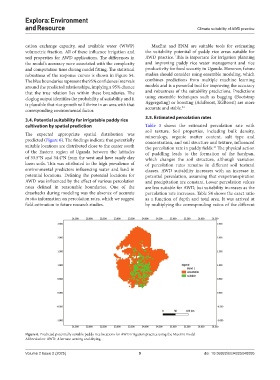
            suitable locations are distributed close to the center south   the percolation rate in paddy fields.  The physical action
                                                                                            31
            of  the Eastern region of  Uganda  between  the  latitudes   of puddling leads to the formation of the hardpan,
            of 33.5°N and 34.4°N from the west and have sandy clay   which changes the soil structure, although variation
            loam soils. This was attributed to the high prevalence of   of percolation rates remains in different soil textural
            environmental predictors influencing water and land in   classes. AWD suitability increases with an increase in
            potential locations. Defining the potential locations for   potential percolation, assuming that evapotranspiration
            AWD was influenced by the effect of various percolation   and precipitation are constant. Lower percolation values
            rates  defined  in  reasonable  boundaries.  One  of  the   are less suitable for AWD, but suitability increases as the
            drawbacks during modeling was the absence of accurate   percolation rate increases. Table S4 shows the exact ratio
            in situ information on percolation rates, which we suggest   as a function of depth and total area. It was arrived at
            field estimation in future research studies.       by multiplying the corresponding ratios of the different


            Figure 6. Predicted potentially suitable paddy rice locations for AWD irrigation practice using the MaxEnt model
            Abbreviation: AWD: Alternate wetting and drying.


            Volume 2 Issue 2 (2025)                         9                           doi: 10.36922/EER025040005

