


Page 114 - EER-2-2
P. 114
Explora: Environment
            and Resource                                                             Climate suitability of AWD practice


            Table 3. Predicted soil percolation rates
            Soil type         Variation of soil percolation with texture
                                        (mm/day)
                               LB         UB          BS
            Clay              0.406556   2.032782   1.219669
            Sandy clay        0.150027   0.450082   0.300055
            Loam sandy        0.31963    1.917782   1.278522
            Sandy clay loam   0.79697    3.984849   2.390909
            Loam              0.002357   0.007072   0.004715
            Sandy loam        0.039779   0.198895   0.119337
            Total percolation  1.71532   8.591462   5.313206
            Note: LB, UB, and BS represent lower bounds, upper bounds, and basic
            settings, respectively.

            textural classes and then summating ratios area for each
            depth and texture class to the total area.

            3.6. Climatic suitability of AWD irrigation practice
            Generally, all the dekads during the drought period were
            appropriate for AWD irrigation practice owing to a water
            deficit from limited rainfall (0 – 6 mm/day) and substantial
            evapotranspiration (3.5 – 8.6 mm/day) within the region.
            AWD suitability for the rainy season (July – October)
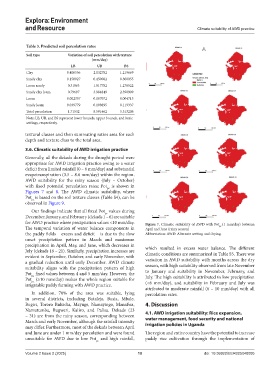
            with fixed potential percolation rates; Pot  is shown in
                                               pc
            Figures  7 and  8. The AWD climatic suitability, where
            Pot is based on the soil texture classes (Table S4), can be
              pc
            observed in Figure 9.
              Our findings indicate that all fixed Pot  values during
                                              pc
            December, January, and February (dekads 1 – 6) are suitable
            for AWD practice where precipitation values <10 mm/day.   Figure 7. Climatic suitability of AWD with Pot (1 mm/day) between
            The temporal variation of water balance components in   April and June (rainy season)  pc
            the paddy fields – excess and deficit – is due to the slow   Abbreviation: AWD: Alternate wetting and drying.
            onset  precipitation pattern  in March  and maximum
            precipitation in April, May, and June, which decreases in
            July (dekads 18 – 21). Similarly, precipitation increases are   which resulted in excess water balance. The different
            evident in September, October, and early November, with   climatic conditions are summarized in Table S5. There was
                                                               variation in AWD suitability with months across the dry
            a gradual reduction until early December. AWD climate   season, with high suitability observed from late November
            suitability aligns with the precipitation pattern of high
            Pot  fixed values between 4 and 5 mm/day. However, the   to January and suitability in November, February, and
              pc
            Pot  (≥10 mm/day) makes the whole region suitable for   July. The high suitability is attributed to low precipitation
              pc
            irrigatable paddy farming with AWD practice.       (<6  mm/day), and suitability in February and July was
                                                               attributed to moderate rainfall (6 – 10 mm/day) with all
              In addition, 70% of the area was suitable, lying   percolation rates.
            in several districts, including Butaleja, Busia, Mbale,
            Bugiri, Tororo Bukedia, Mayuge, Namayingo, Manafwa,   4. Discussion
            Namutumba, Bugweri, Kaliro, and Palisa. Dekads (23
            – 31) are from the rainy season, corresponding between   4.1. AWD irrigation suitability: Rice expansion,
            March and early November, although the rainfall intensity   water management, food security and national
                                                               irrigation policies in Uganda
            may differ. Furthermore, most of the dekads between April
            and June are under 1 mm/day percolation and were found   The region and entire country have the potential to increase
            unsuitable for AWD due to low Pot  and high rainfall,   paddy rice cultivation through the implementation of
                                          pc

            Volume 2 Issue 2 (2025)                         10                          doi: 10.36922/EER025040005

