


Page 110 - EER-2-2
P. 110
Explora: Environment
            and Resource                                                             Climate suitability of AWD practice


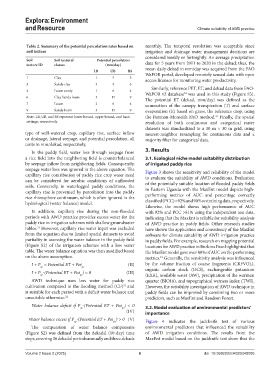
            Table 2. Summary of the potential percolation rates based on   monthly. The temporal resolution was acceptable since
            soil texture                                       irrigation and drainage water management decisions are
                                                               considered weekly or fortnightly. An average precipitation
            Soil        Soil textural     Potential percolation
            texture ID  classes               (mm/day)         data for 5 years from 2011 to 2020 in the dekad; thus, the
                                                               mean daily dekad in mm/day was acquired from the FAO
                                         LB     UB     BS
            1           Clay              1      5      3      WaPOR portal, developed remotely sensed data with open
                                                               access licenses for monitoring water productivity.
            3           Sandy clay        3      9      6
                                                                 Similarly, reference PET, ET, and dekad data from FAO-
            4           Loam sandy        1      6      4      WaPOR v2 database  was used in this study (Figure S3).
                                                                               32
            6           Clay Sandy loam   3      15     9      The potential ET (dekad, mm/day) was defined as the
            7           Loam              2      6      4      summation of the canopy transpiration (T) and surface
            9           Sandy loam        3      15     9      evaporation (E) based on grass, the reference crop, using
                                                                                             33
            Note: LB, UB, and BS represent lower bound, upper bound, and basic   the Penman-Monteith FAO method.  Finally, the spatial
            settings, respectively.                            resolution of both continuous and categorical raster
                                                               datasets was standardized to a 30 m × 30 m grid, using
            type of well-watered crop, capillary rise, surface inflow   nearest-neighbor resampling for continuous data and a
            or drainage, lateral seepage, and potential percolation, all   majority filter for categorical data.
            units in mm/dekad, respectively.
              In the paddy field, water loss through seepage from   3. Results
            a rice field into the neighboring field is counterbalanced   3.1. Ecological niche model suitability distribution
            by seepage inflow from neighboring fields. Consequently,   of irrigated paddy rice
            seepage water loss was ignored in the above equation. The   Figure 3 shows the sensitivity and reliability of the model
            capillary rise contribution of paddy rice crop water need   to evaluate the suitability of AWD conditions. Evaluation
            can be considered for aerobic conditions of unflooded   of the potentially suitable location of flooded paddy fields
            soils. Conversely, in waterlogged paddy conditions, the
            capillary rise is prevented by percolation into the paddy   in Eastern Uganda with the MaxEnt model depicts high-
            rice rhizosphere continuum, which is often ignored in the   performing metrics of AUC and percentage correctly
            hydrological (water balance) model.                classified (PCC) >92% and 90% on training data, respectively.
                                                               Likewise,  the  model  shows  high  performance  of  AUC
              In addition, capillary rise during the non-flooded   with 92% and PCC >81% using the independent test data,
            periods with AWD practice provides excess water for the   indicating that the MaxEnt is reliable for suitability analysis
            paddy rice in irrigation schemes with shallow groundwater   of AWD  practice in  paddy fields.  Other research  studies
            tables.  However, capillary rise water input was excluded   have shown the application and consistency of the MaxEnt
                 31
            from the equation due to limited spatial datasets to avoid   software for climate suitability of AWD irrigation practice
            partiality in assessing the water balance in the paddy field   in paddy fields. For example, research on mapping potential
            (Figure S2) of  the irrigation schemes  with a low water   locations for AWD practice in Burkina Faso highlighted that
            table. The water balance equation was then modified based   the MaxEnt model gave over 80% of AUC on the performing
            on the above assumption.                           metrics.  Generally, the sensitivity analysis was influenced
                                                                     15
              I + P  = Potential ET + Pot pc           (II)    by the volume fraction of coarse fragments (CRFVOL),
                  cp
              I + P -(Potential ET + Pot ) = 0         (III)   organic carbon stock (OCS), exchangeable potassium
                                                               (EXK), available water (AW), precipitation of the warmest
                                   pc
                  cp
              AWD technique uses less water for paddy rice     quarter (BIO18), and topographical wetness index (TWI).
                                                     31
            cultivation compared to the flooding method (CF)  and   However, the suitability investigation of AWD technique in
            is suitable for each period with a deficit water balance and   paddy fields can be improved by combining two or more
            unsuitable otherwise. 22                           predictors, such as MaxEnt and Random Forest.
              Water balance deficit if P -(Potential ET + Pot ) < 0  3.2. Model evaluation of environmental predictors’
                                   cp
                                                     pc
                                                       (IV)    importance
             Water balance excess if P -(Potential ET + Pot ) > 0  (V)  Figure  4 indicates the jackknife test of various
                                 cp
                                                 pc
              The computation of water balance components      environmental predictors that influenced the suitability
            (Figure S2) was defined from the dekadal (10-day) time   of AWD irrigation conditions. The results from the
            steps, covering 36 dekadal periods annually and three dekads   MaxEnt model based on the jackknife test show that the

            Volume 2 Issue 2 (2025)                         6                           doi: 10.36922/EER025040005

