


Page 107 - EER-2-2
P. 107
Explora: Environment
            and Resource                                                             Climate suitability of AWD practice


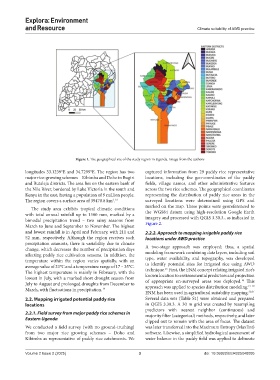
                                 Figure 1. The geographical site of the study region in Uganda. Image from the authors

            longitudes 33.1239°E and 34.7299°E. The region has two   captured information from 29 paddy rice representative
            major rice-growing schemes – Kibimba and Doho in Bugiri   locations, including the geo-coordinates of the paddy
            and Butaleja districts. The area lies on the eastern bank of   fields, village  names, and  other  administrative features
            the Nile River, bordered by Lake Victoria in the south and   across the two rice schemes. The geographical coordinates
            Kenya in the east, having a population of 9 million people.   representing the distribution of paddy rice areas in the
            The region covers a surface area of 39478.8 km .   surveyed locations were determined using GPS and
                                                 2 13
              The study area exhibits tropical climatic conditions   marked on the map. These points were georeferenced to
            with total annual rainfall up to 1500  mm, marked by a   the WGS84 datum using high-resolution Google Earth
            bimodal precipitation trend – two rainy seasons from   imagery and processed with QGIS 3.30.3., as indicated in
                                                               Figure 2.
            March to June and September to November. The highest
            and lowest rainfall is in April and February, with 211 and   2.2.2. Approach to mapping irrigable paddy rice
            52  mm, respectively. Although the region receives such   locations under AWD practice
            precipitation amounts, there is variability due to climate
            change, which decreases the number of precipitation days   A two-stage approach was employed; thus, a spatial
            affecting paddy rice cultivation seasons. In addition, the   modeling framework combining data layers, including soil
            temperature  within  the  region  varies  spatially,  with  an   type, water availability, and topography, was developed
            average value of 23°C and a temperature range of 17 – 35°C.   to identify potential sites for irrigated rice using AWD
                                                               technique.  First, the ENM concept relating irrigated rice’s
                                                                       15
            The highest temperature is mainly in February, with the
            lowest in July, with a marked short drought season from   known location to environmental predictors and projection
                                                                                                        16
            July to August and prolonged droughts from December to   of appropriate un-surveyed areas was deployed.  This
                                                               approach was applied to species distribution modeling.
                                                                                                           17-19
            March, with fluctuations in precipitation. 14
                                                               ENM has been used in agricultural suitability mapping. 20,21
            2.2. Mapping irrigated potential paddy rice        Several data sets (Table S1) were obtained and prepared
            locations                                          in QGIS 3.30.3. A 30 m grid was created by resampling
                                                               predictors with nearest neighbor (continuous) and
            2.2.1. Field survey from major paddy rice schemes in   majority filter (categorical) methods, respectively, and later
            Eastern Uganda                                     clipped out to remain with the area of focus. The dataset
            We conducted a field survey (with no ground-truthing)   was later transferred into the Maximum Entropy (MaxEnt)
            from two major rice growing schemes – Doho and     software. Likewise, a simplified hydrological assessment of
            Kibimba as representative of paddy rice catchments. We   water balance in the paddy field was applied to delineate


            Volume 2 Issue 2 (2025)                         3                           doi: 10.36922/EER025040005

