


Page 112 - EER-2-2
P. 112
Explora: Environment
            and Resource                                                             Climate suitability of AWD practice


            3.3. Covariance response curves                    and 425 mm of precipitation during the warmest quarter

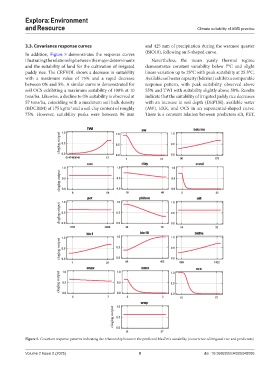
            In addition,  Figure  5  demonstrates the response curves   (BIO18), following an S-shaped curve.
            illustrating the relationship between the major determinants   Nevertheless, the mean yearly thermal regime
            and the suitability of land for the cultivation of irrigated   demonstrates constant variability below 7°C and slight
            paddy rice. The CRFVOL shows a decrease in suitability   linear variation up to 25°C with peak suitability at 25.5°C.
            with a maximum value of 75% and a rapid decrease   Available soil water capacity (bdcrim) exhibits a comparable
            between 0% and 5%. A similar curve is demonstrated for   response pattern, with peak suitability observed above
            soil OCS exhibiting a maximum suitability of 100% at 10   55% and TWI with suitability slightly above 50%. Results
            tons/ha. Likewise, a decline to 0% suitability is observed at   indicate that the suitability of irrigated paddy rice decreases
            57 tons/ha, coinciding with a maximum soil bulk density   with an increase in soil depth (DEPTH), available water
            (BDCRIM) of 175 kg/m  and a soil clay content of roughly   (AW), EXK, and OCS in an exponential-shaped curve.
                               3
            75%.  However,  suitability  peaks  were  between  96  mm   There is a constant relation between predictors silt, PET,


            Figure 5. Covariant response patterns indicating the relationship between the predicted MaxEnt’s suitability (occurrence of irrigated rice and predictors)


            Volume 2 Issue 2 (2025)                         8                           doi: 10.36922/EER025040005

