


Page 128 - EER-2-2
P. 128
Explora: Environment
            and Resource                                                       Microemulsion-based canola oil extraction


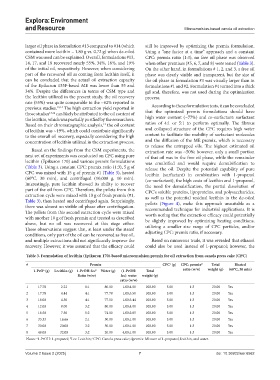
            larger oil phase in formulation #13 compared to #14 (which   still be improved by optimizing the premix formulation.
            contained more lecithin – 1.80 g vs. 0.72 g) when de-oiled   Using a “one factor at a time” approach and a constant
            CSM was used can be explained. Overall, formulations #13,   CPC: premix ratio (1:3), no free oil phase was observed
            14, 17, and 18 recovered nearly 55%, 34%, 16%, and 19%   when other premixes (#5, 6, 7, and 8) were tested (Table 3).
            of the initial oil, respectively. However, when considering   On the other hand, in formulations # 1, 2, and 3, a free oil
            part of the recovered oil as coming from lecithin itself, it   phase was clearly visible and transparent, but the size of
            can be concluded that the actual oil extraction capacity   the oil phase in formulation #3 was visually larger than in
            of the Epikuron 135F-based ME was lower than 55 and   formulations #1 and #2. Formulation #4 turned into a thick
            34%. Despite the differences in terms of CSM type and   gel and, therefore, was not used during the optimization
            the lecithin utilized in the present study, the oil recovery   process.
            rate (55%) was quite comparable to the ~62% reported in
            previous studies. 13,14  The high extraction yield reported in   According to these formulation tests, it can be concluded
            those studies 13,14  can likely be attributed to the oil content of   that the optimized premix formulations should have
            the lecithin, which was partially purified by the researchers.   high water content (~77%) and co-surfactant: surfactant
            Based on their chromatographic analysis,  the oil content   ratios of 4:1 or 5:1 to perform optimally. The fibrous
                                             13
            of lecithin was ~19%, which could contribute significantly   and collapsed structure of the CPC requires high water
            to the overall oil recovery, especially considering the high   content to facilitate the mobility of surfactant molecules
            concentration of lecithin utilized in the extraction process.  and the diffusion of the ME premix, which is necessary
                                                               to release the entrapped oils. The highest estimated oil
              Based on the findings from the CSM experiments, the   extraction rate was ~50%; however, only a small portion
            next set of experiments was conducted on CPC using pure   of that oil was in the free oil phase, while the remainder
            lecithin (Epikuron 170) and various premix formulations   was  emulsified  and  would require demulsification to
            (Table 3). Using a constant CPC: premix ratio (1:3), 5 g of   release the oil. Despite the potential capability of pure
            CPC was mixed with 15 g of premix #1 (Table 3), heated   lecithin (surfactant) in combination with 1-propanol
            (60°C, 30  min), and centrifuged (10,000  g, 10  min).   (co-surfactant), the high costs of lecithin and 1-propanol,
            Interestingly,  pure  lecithin  showed  its  ability  to  recover   the need for demulsification, the partial dissolution of
            part of the oil from CPC. Therefore, the pellets from this   CPC’s soluble proteins, lipoproteins, and polysaccharides,
            extraction cycle were mixed with 10 g of fresh premix (#1,   as well as the potential residual lecithin in the de-oiled
            Table 3), then heated and centrifuged again. Surprisingly,   pellets  (Figure  4),  make  this  approach  unsuitable  as  a
            there was almost no visible oil phase after centrifugation.   recommended technique for industrial applications. It is
            The pellets from this second extraction cycle were mixed   worth noting that the extraction efficacy could potentially
            with another 10 g of fresh premix and treated as described
            above, but no oil was recovered at this stage either.   be slightly improved by optimizing heating conditions,
            These observations suggest that, at least under the stated   utilizing a  smaller  size  range  of CPC  particles,  and/or
            conditions, only part of the oil can be recovered as free oil,   adjusting CPC: premix ratio, if necessary.
            and multiple extractions did not significantly improve the   Based on numerous trials, it was revealed that ethanol
            recovery. However, it was assumed that the efficacy could   could also be used instead of 1-propanol; however, the
            Table 3. Formulation of lecithin (Epikuron 170)‑based microemulsion premix for oil extraction from canola press cake (CPC)

                                                                         c
            #                          Premix                         CPC  (g)  CPC: premix   d  Total   Heated
               1‑PrO  (g)  Lecithin (g)  1‑PrOH: lec   Water (g)  (1‑PrOH:   Total   ratio (w/w)  weight (g)  (60°C, 30 min)
                                          b
                   a
                                  Ratio (w/w)       lec): water   weight (g)
                                                    ratio (w/w)
            1    17.78     2.22      8:1      80.00  1.00:4.00  100.00  5.00      1:3      20.00  Yes
            2    17.78     4.44      4:1      77.78  1.00:3.50  100.00  5.00      1:3      20.00  Yes
            3    18.00     4.50      4:1      77.50  1.00:3.44  100.00  5.00      1:3      20.00  Yes
            4    12.00     8.00      3:2      80.00  1.00:4.00  100.00  5.00      1:3      20.00  Yes
            5    18.50     7.50      5:2      74.00  1.00:2.85  100.00  5.00      1:3      20.00  Yes
            6    33.33     16.66     2:1      50.00  1.00:1.00  100.00  5.00      1:3      20.00  Yes
            7    30.00     20.00     3:2      50.00  1.00:1.00  100.00  5.00      1:3      20.00  Yes
            8    48.00     32.00     3:2      20.00  4.00:1.00  100.00  5.00      1:3      20.00  Yes
            Notes:  1-PrOH: 1-propanol;  Lec: Lecithin;  CPC: Canola press cake; dpremix: Mixture of 1-propanol, lecithin, and water.
                               b
                                        c
                 a
            Volume 2 Issue 2 (2025)                         7                                doi: 10.36922/eer.6562

