


Page 126 - EER-2-2
P. 126
Explora: Environment
            and Resource                                                       Microemulsion-based canola oil extraction


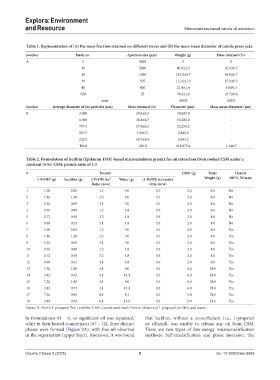
            Table 1. Representation of (A) the mass fraction retained on different sieves and (B) the mass mean diameter of canola press cake
            Section              Mesh no.              Aperture size (µm)  Weight (g)        Mass retained (%)
            A                       5                       4000               0                   0
                                    10                      2000            40.0±2.2             10.0±0.5
                                    18                      1000            147.2±2.7            36.8±0.7
                                    30                       595            111.6±1.3            27.9±0.3
                                    40                       420            22.4±1.4             5.6±0.3
                                   500                       25             78.8±1.6             19.7±0.4
                                            Sum                              400.0                100.0
            Section    Average diameter of the particles (µm)  Mass retained (%)  Diameter (µm)  Mass mean diameter (µm)
            B                      3,000                   10.0±0.5         30,000.0               -
                                   1,500                   36.8±0.7         55,200.0               -
                                   797.5                   27.9±0.3         22,250.2               -
                                   507.5                   5.6±0.3           2,842.0               -
                                   222.5                   19.7±0.4          4,383.2               -
                                   Total                    100.0           114,675.4            1,146.7


            Table 2. Formulation of lecithin (Epikuron 135F)‑based microemulsion premix for oil extraction from cooked CSM under a
            constant (w/w) CSM: premix ratio of 1:3
            #                              Premix                             CSM  (g)    Total      Heated
                                                                                  c
                      a
                 1‑PrOH  (g)  Lecithin (g)  1‑PrOH: lec   b  Water (g)  (1‑PrOH: lec):water   Weight (g)  (60°C, 30 min)
                                        Ratio (w/w)             ratio (w/w)
            1       1.00       2.00        1:2        3.0          1:1           2.0       8.0    No
            2       1.80       1.20        3:2        3.0          1:1           2.0       8.0    No
            3       2.40       0.60        4:1        3.0          1:1           2.0       8.0    No
            4       0.40       0.80        1:2        4.8          1:4           2.0       8.0    No
            5       0.72       0.48        3:2        4.8          1:4           2.0       8.0    No
            6       0.96       0.24        4:1        4.8          1:4           2.0       8.0    No
            7       1.00       2.00        1:2        3.0          1:1           2.0       8.0    Yes
            8       1.80       1.20        3:2        3.0          1:1           2.0       8.0    Yes
            9       2.40       0.60        4:1        3.0          1:1           2.0       8.0    Yes
            10      0.40       0.80        1:2        4.8          1:4           2.0       8.0    Yes
            11      0.72       0.48        3:2        4.8          1:4           2.0       8.0    Yes
            12      0.96       0.24        4:1        4.8          1:4           2.0       8.0    Yes
            13      7.20       1.80        4:1        9.0          1:1           6.0      24.0    Yes
            14      2.82       0.72        4:1        14.4         1:4           6.0      24.0    Yes
            15      7.20       1.80        4:1        9.0          1:1           6.0      24.0    Yes
            16      2.82       0.72        4:1        14.4         1:4           6.0      24.0    Yes
            17      7.20       0.90        8:1        8.1          1:1           5.4      21.6    Yes
            18      2.88       0.36        8:1        13.0         1:4           5.4      21.6    Yes
                 a
                                        c
                               b
            Notes:  1-PrOH: 1-propanol;  lec: Lecithin;  CSM: Canola seed meal; Premix: Mixture of 1-propanol, lecithin, and water.
            In formulations #1 – 6, no significant oil was separated,   that lecithin, without a co-surfactant (i.e., 1-propanol
            while in their heated counterparts (#7 – 12), three distinct   or ethanol), was unable to release any oil from CSM.
            phases were formed (Figure  3A), with free oil observed   There are two types of low-energy microemulsification
            in the supernatant (upper layer). Moreover, it was found   methods: Self-emulsification and phase inversion. The


            Volume 2 Issue 2 (2025)                         5                                doi: 10.36922/eer.6562

