


Page 125 - EER-2-2
P. 125
Explora: Environment
            and Resource                                                       Microemulsion-based canola oil extraction


            total oil content of each set of experiments was analyzed,   Given the importance of moisture content in the CPC,
            and the oil extraction rate was calculated based on the oil   this parameter was also measured. The average moisture
            content of the corresponding batch. It is important to note   content  (based  on  at  least  three  replications) was  6.4%.
            that each measurement was repeated at least 3 times, and   According to industrial regulations, the moisture content
            the average of the replicates was reported.        of seeds must be ≤6%, or they must be dried before further
                                                               processing. 6,27
            3. Results and discussion
                                                                 Regarding the oil content of the CPC, it contained
            3.1. Chemical and physical characteristics of CPC  15.8 ± 0.3 wt% of oil. It is noteworthy that the initial oil
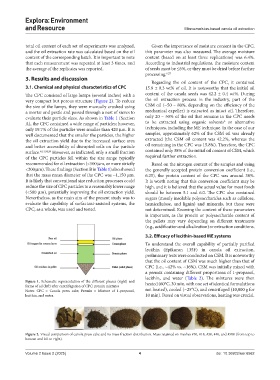
            The CPC consisted of large lumps (several inches) with a   content of the canola seeds was 42.2 ± 0.4 wt%. During
            very compact but porous structure (Figure 2). To reduce   the  oil  extraction  process  in  the  industry,  part  of  the
            the size of the lumps, they were manually crushed using   CSM oil (~50 – 80%, depending on the efficiency of the
            a mortar and pestle and passed through a nest of sieves to   mechanical expeller) is extracted as intact oil. Therefore,
            evaluate their particle sizes. As shown in Table 1 (Section   only 20 – 50% of the oil that remains in the CPC needs
                                                                                                6
            A), the CPC contained a wide range of particles; however,   to be extracted using organic solvents  or alternative
            only 19.7% of the particles were smaller than 420 μm. It is   techniques, including the ME technique. In the case of our
            well documented that the smaller the particles, the higher   samples, approximately 62% of the CSM oil was already
            the oil extraction yield due to the increased surface area   extracted (the CSM oil content was 42.2%, whereas the
            and better accessibility of disrupted cells on the particle   oil remaining in the CPC was 15.8%). Therefore, the CPC
            surface. 6,13,24,26  However, as indicated, only a small fraction   contained only 38% of the initial oil content of CSM, which
            of the CPC  particles  fell within  the size range  typically   required further extraction.
            recommended for oil extraction (<500 μm, or more strictly   Based on the nitrogen content of the samples and using
            <200 μm). These findings (Section B in Table 1) also showed   the generally accepted protein conversion coefficient (i.e.,
            that the mass mean diameter of the CPC was ~1,150 μm.   6.25),  the  protein  content  of  the  CPC  was  around  38%.
            It is likely that conventional size reduction processes could   It is worth noting that this conversion coefficient may be
            reduce the size of CPC particles to a reasonably lower range   high, and it is believed that the actual value for most foods
            (<500 μm), potentially improving the oil extraction yield.   should be between 5.1 and 6.0. The CPC also contained
            Nevertheless, as the main aim of the present study was to   sugars (mostly insoluble polysaccharides such as cellulose,
            evaluate the capability of surfactant-assisted systems, the   hemicellulose, and lignin) and minerals, but these were
            CPC, as a whole, was used and tested.              not determined. Knowing the content of these parameters
                                                               is important, as the protein or polysaccharide content of
                                                               the  pellets  may  vary  depending  on  different  treatments
                                                               (e.g., acidification and alkalization) or extraction conditions.

                                                               3.2. Efficacy of lecithin-based ME systems
                                                               To understand the overall capability of partially purified
                                                               lecithin (Epikuron  135F)  in canola  oil  extraction,
                                                               preliminary tests were conducted on CSM. It is noteworthy
                                                               that the oil content of CSM was much higher than that of
                                                               CPC (i.e., ~42% vs. ~16%). CSM was initially mixed with
                                                               a premix containing different proportions of 1-propanol,
                                                               lecithin, and water (Table  2). The mixtures were then
            Figure  1. Schematic representation of the different phases (right) and   heated (60°C, 30 min, with one set of identical formulations
            forms of oil (left) after centrifugation of CPC: premix mixtures
            Notes:  CPC = Canola press cake; Premix = Mixture of 1-propanol,   not heated), cooled (~25°C), and centrifuged (10,000 g for
            lecithin, and water.                               10 min). Based on visual observations, heating was crucial.


            Figure 2. Visual comparison of canola press cake and its mass fraction distribution. Mass retained on meshes #10, #18, #30, #40, and #500 (from top to
            bottom and left to right).


            Volume 2 Issue 2 (2025)                         4                                doi: 10.36922/eer.6562

