


Page 93 - EER-2-2
P. 93
Explora: Environment
            and Resource                                               Assessing ecosystems by land cover and landscapes


            period from 2017 to 2023. Finally, we discuss the primary   practices,  such  as  overgrazing,  irrational  irrigation,
            challenges associated with this approach for ecosystem   insufficient reforestation, weak regulation of construction
            accounting in Armenia.                             in natural areas, and the overuse of biological resources
                                                               (firewood, medicinal, edible, and ornamental plants)
            2. Materials and methods                           by local populations. Most of the semi-desert zone is
            2.1. Study area                                    used for irrigated agriculture, which causes soil erosion,
                                                               secondary salinization, and desertification, contributing
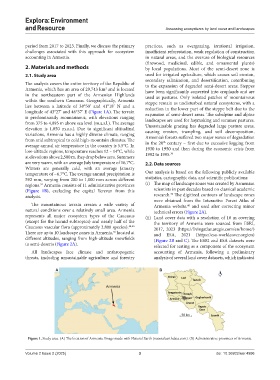
            The analysis covers the entire territory of the Republic of   to the expansion of degraded semi-desert areas. Steppes
            Armenia, which has an area of 29,743 km  and is located   have been significantly converted into croplands and are
                                              2
            in the northeastern part of the Armenian Highlands   used  as  pastures.  Only  isolated  patches  of  mountainous
            within the southern Caucasus. Geographically, Armenia   steppe remain as undisturbed natural ecosystems, with a
            lies between a latitude of 38°50’ and 41°18’ N and a   reduction in the lower part of the steppe belt due to the
            longitude of 43°27’ and 46°37’ E (Figure 1A). The terrain   expansion of semi-desert areas. The subalpine and alpine
            is predominantly mountainous, with elevations ranging   landscapes are used for haymaking and summer pastures.
            from 375 to 4,095 m above sea level (m.a.s.l.). The average   Unsustainable grazing has degraded large pasture areas,
            elevation is 1,850  m.a.s.l. Due to significant altitudinal   causing erosion, trampling, and soil decomposition.
            variations, Armenia has a highly diverse climate, ranging   Armenia’s forests suffered two major waves of degradation
            from arid subtropical to cold high-mountain climates. The   in the 20  century – first due to excessive logging from
                                                                      th
            average annual air temperature in the country is 5.5°C. In   1930 to 1950 and then during the economic crisis from
            low-altitude regions, temperature reaches 12 – 14°C, while   1992 to 1995. 36
            at elevations above 2,500 m, they drop below zero. Summers
            are very warm, with an average July temperature of 16.7°C.   2.2. Data sources
            Winters are generally cold, with an average January
            temperature of −6.7°C. The average annual precipitation is   Our analysis is based on the following publicly available
            592 mm, varying from 200 to 1,000 mm across different   statistics, cartographic data, and scientific publications:
            regions.  Armenia consists of 11 administrative provinces   (i)  The map of landscape zones was created by Armenian
                  34
            (Figure  1B), excluding the capital Yerevan from this   scientists in past decades based on classical academic
                                                                          36
            analysis.                                             research.  The digitized contours of landscape zones
                                                                  were obtained from the Interactive Forest Atlas of
              The  mountainous  terrain  creates  a  wide  variety  of   Armenia website.  and used after correcting minor
                                                                                 40
            natural conditions over a relatively small area. Armenia   technical errors (Figure 2A).
            represents all major ecosystem types of the Caucasus   (ii)  Land cover data with a resolution of 10 m covering
            (except for the humid subtropics) and nearly half of the   the territory of Armenia were sourced from ESRI,
            Caucasus vascular flora (approximately 3,800 species). 34,36    2017, 2023 (https://livingatlas.arcgis.com/en/home/)
            There are up to 10 landscape zones in Armenia,  located at   and ESA, 2021 (https://esa-worldcover.org/en)
                                                 36
            different altitudes, ranging from high-altitude snowfields   (Figure 2B and C). The ESRI and ESA datasets were
            to semi-deserts (Figure 2A).                          selected for testing as a component of the ecosystem
              All  landscapes  face  climate  and  anthropogenic   accounting of Armenia, following a preliminary
            threats, including unsustainable agriculture and forestry   analysis of several land cover datasets, which indicated

                         A                                           B


             Figure 1. Study area. (A) The location of Armenia. Image made with Natural Earth (naturalearthdata.com). (B) Administrative provinces of Armenia.


            Volume 2 Issue 2 (2025)                         3                                doi: 10.36922/eer.4996

