


Page 94 - EER-2-2
P. 94
Explora: Environment
            and Resource                                               Assessing ecosystems by land cover and landscapes


                         A                     B                     C


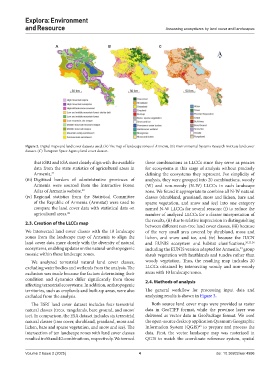
            Figure 2. Digital maps and land cover datasets used. (A) The map of landscape zones of Armenia. (B) Environmental Systems Research Institute land cover
            dataset. (C) European Space Agency land cover dataset.

               that ESRI and ESA most closely align with the available   these combinations as LLCCs since they serve as proxies
               data from the state statistics of agricultural areas in   for ecosystems at this stage of analysis without precisely
               Armenia. 41                                     defining the ecosystems they represent. For simplicity of
            (iii) Digitized borders of administrative provinces of   analysis, they were grouped into 20 combinations, woody
               Armenia were sourced from the Interactive Forest   (W) and non-woody (N-W) LLCCs in each landscape
               Atlas of Armenia website. 40                    zone. We found it appropriate to combine all N-W natural
            (iv)  Regional statistics from the Statistical Committee   classes (shrubland, grassland, moss and lichen, bare and
               of the Republic of Armenia (Armstat) were used to   sparse vegetation, and snow and ice) into one category
               compare the land cover data with statistical data on   named N-W LLCCs for several reasons: (i) to reduce the
               agricultural areas. 42                          number of analyzed LLCCs for a clearer interpretation of
                                                               the results, (ii) due to relative imprecision in distinguishing
            2.3. Creation of the LLCCs map
                                                               between different non-tree land cover classes, (iii) because
            We intersected land cover classes with the 10 landscape   of  the  very  small  area  covered  by  shrubland,  moss  and
            zones from the landscape map of Armenia to align the   lichen,  and snow and ice, and (iv) because  the IUCN
            land cover data more closely with the diversity of natural   and EUNIS ecosystem and habitat classifications, 20,22,26
            ecosystems, enabling updates on the natural-anthropogenic   including the EUNIS version adapted for Armenia,  group
                                                                                                       34
            mosaic within these landscape zones.               shrub vegetation with heathlands and tundra rather than
              We analyzed terrestrial natural land cover classes,   woody vegetation. Thus, the resulting map includes 20
            excluding water bodies and wetlands from the analysis. The   LLCCs  obtained  by intersecting woody and  non-woody
            exclusion was made because the factors determining their   areas with 10 landscape zones.
            condition and dynamics differ significantly from those   2.4. Methods of analysis
            affecting terrestrial ecosystems. In addition, anthropogenic
            territories, such as croplands and built-up areas, were also   The general workflow for processing input data and
            excluded from the analysis.                        analyzing results is shown in Figure 3.
              The ESRI land cover dataset includes four terrestrial   Both source land cover maps were provided as raster
            natural classes (trees, rangelands, bare ground, and snow/  data in GeoTIFF format, while the province layer was
            ice). In comparison, the ESA dataset includes six terrestrial   delivered as vector data in GeoPackage format. We used
            natural classes (tree cover, shrubland, grassland, moss and   the open-source desktop application Quantum Geographic
                                                                                      43
            lichen, bare and sparse vegetation, and snow and ice). The   Information System (QGIS)  to prepare and process the
            intersection of ten landscape zones with land cover classes   data. First, the vector landscape map was rasterized in
            resulted in 60 and 40 combinations, respectively. We termed   QGIS to match the coordinate reference system, spatial


            Volume 2 Issue 2 (2025)                         4                                doi: 10.36922/eer.4996

