


Page 96 - EER-2-2
P. 96
Explora: Environment
            and Resource                                               Assessing ecosystems by land cover and landscapes


                         A


                         B                                             C


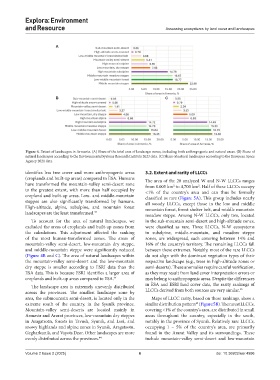
            Figure 4. Extent of landscapes in Armenia. (A) Share of the total area of landscape zones, including both anthropogenic and natural areas. (B) Share of
            natural landscapes according to the Environmental Systems Research Institute 2023 data. (C) Share of natural landscapes according to the European Space
            Agency 2021 data.

            identifies less tree cover and more anthropogenic areas   3.2. Extent and rarity of LLCCs
            (croplands and built-up areas) compared to ESA. Humans   The area of the 20 analyzed W and N-W LLCCs ranges
            have  transformed  the  mountain-valley  semi-desert  zone   from 0.005 km  to 4,700 km . Half of these LLCCs occupy
                                                                           2
                                                                                     2
            to the greatest extent, with more than half occupied by   <1% of  the country’s area and can thus  be formally
            cropland and built-up areas. Low- and middle-mountain   classified as rare (Figure 5A). This group includes nearly
            steppes are also significantly transformed by humans.   all woody LLCCs, except those in the low and middle
            High-altitude, alpine, subalpine, and mountain forest   mountain forest, forest shelter belt, and middle mountain
            landscapes are the least transformed. 44           meadow steppe. Among N-W LLCCs, only two, located
              To account for the area of natural landscapes, we   in the sub-mountain semi-desert and high-altitude zones,
            excluded the areas of croplands and built-up zones from   were classified as rare. Three LLCCs, N-W ecosystems
            the  calculations. This  adjustment  affected  the ranking   in subalpine, middle-mountain, and meadow steppe
            of the most human-transformed zones. The areas of   zones, are widespread, each covering between 14% and
            mountain-valley semi-desert, low-mountain dry steppe,   16% of the country’s territory. The remaining LLCCs fall
            and  middle-mountain  steppe  were  significantly  reduced   between these extremes. Notably, most of the rare LLCCs
            (Figure 4B and C). The area of natural landscapes within   do not align with the dominant vegetation types of their
            the mountain-valley semi-desert and the low-mountain   respective landscape (e.g., trees in high-altitude zones or
            dry steppe is smaller according to ESRI data than the   semi-deserts). These anomalies require careful verification,
            ESA data. This is because ESRI identifies a larger area of   as they may result from land cover interpretation errors or
            croplands and built-up areas compared to ESA. 44   may belong to anthropogenic areas. Despite the differences
              The landscape area is extremely unevenly distributed   in ESA and ESRI land cover data, the rarity rankings of
            across the provinces. The smallest landscape zone by   LLCCs derived from both sources are very similar. 45
            area, the submountain semi-desert, is located only in the   Maps of LLCC rarity, based on these rankings, show a
            extreme south of the country, in the Syunik province.   similar distribution pattern  (Figure 5B). The rarest LLCCs,
                                                                                    45
            Mountain-valley  semi-deserts  are  located  mainly  in   covering <1% of the country’s area, are distributed in small
            Armavir and Ararat provinces, low-mountain dry steppes   areas throughout the country, especially in the south,
            in Aragatsotn, forests in Tavush, Syunik, and Lori, and   notably in the province of Syunik. Relatively rare LLCCs,
            snowy highlands and alpine zones in Syunik, Aragatsotn,   occupying 1 – 5% of the country’s area, are primarily
            Gegharkunik, and Vayots Dzor. Other landscapes are more   found in the Ararat Valley and its surroundings. These
            evenly distributed across the provinces. 44        include mountain-valley semi-desert and low-mountain


            Volume 2 Issue 2 (2025)                         6                                doi: 10.36922/eer.4996

