


Page 51 - EER-2-3
P. 51
Explora: Environment
            and Resource                                                        Maize–pigeon pea intercropping in Ghana


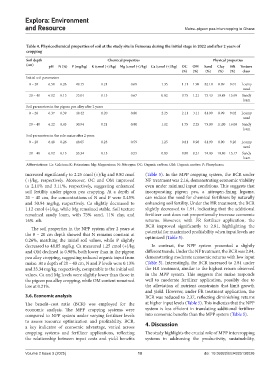
            Table 4. Physicochemical properties of soil at the study site in Fumesua during the initial stage in 2022 and after 2 years of
            cropping
            Soil depth                         Chemical properties                          Physical properties
            (cm)      pH  N (%)  P (mg/kg)  K (cmol (+)/kg)  Mg (cmol (+)/kg)  Ca (cmol (+)/kg)  OC   OM   Sand   Clay   Silt   Texture
                                                                              (%)  (%)  (%)   (%)  (%)  class
            Initial soil parameters
             0 – 20   6.50  0.26  49.15     0.21         0.69         1.35    1.11  1.98  82.10  8.89  9.01  Loamy
                                                                                                        sand
             20 – 40  6.02  0.13  33.04     0.15         0.67         0.82    0.75  1.21  73.43  10.88 15.69  Sandy
                                                                                                        loam
            Soil parameters in the pigeon pea alley after 2 years
             0 – 20   6.37  0.39  48.42     0.20         0.80         2.25    2.11  3.11  81.99  8.99  9.02  Loamy
                                                                                                        sand
             20 – 40  6.22  0.45  30.94     0.21         0.80         1.12    1.75  2.25  73.00  11.00 16.00  Sandy
                                                                                                        loam
            Soil parameters in the sole maize after 2 years
             0 – 20   6.48  0.26  48.05     0.23         0.59         1.25    0.81  0.98  81.90  8.90  9.20  Loamy
                                                                                                        sand
             20 – 40  6.12  0.13  33.34     0.15         0.55         0.83    0.80  0.21  74.03  10.80 15.17  Sandy
                                                                                                        loam
            Abbreviations: Ca: Calcium; K: Potassium; Mg: Magnesium; N: Nitrogen; OC: Organic carbon; OM: Organic matter; P: Phosphorus.

            increased significantly to 2.25 cmol (+)/kg and 0.80 cmol   (Table 5). In the MPP cropping system, the BCR under
            (+)/kg, respectively. Moreover, OC and OM improved   NF treatment was 2.16, demonstrating economic viability
            to 2.11% and 3.11%, respectively, suggesting enhanced   even under minimal input conditions. This suggests that
            soil fertility under pigeon pea cropping. At a depth of   incorporating pigeon pea, a nitrogen-fixing legume,
            20 – 40 cm, the concentrations of N and P were 0.45%   can reduce the need for chemical fertilizers by naturally
            and 30.94  mg/kg, respectively. Ca slightly decreased to   enhancing soil fertility. Under the HR treatment, the BCR
            1.12 cmol (+)/kg, while Mg remained stable. Soil texture   slightly decreased to 1.91, indicating that the additional
            remained sandy loam, with 73% sand, 11% clay, and   fertilizer cost does not proportionally increase economic
            16%  silt.                                         returns. However, with FR fertilizer application, the
              The soil properties in the NPP system after 2 years at   BCR improved significantly to 2.81, highlighting the
            the 0 – 20 cm depth showed that N remains constant at   potential for maximized profitability when input levels are
                                                               optimized (Table 5).
            0.26%, matching the initial soil values, while P slightly
            decreased to 48.05 mg/kg. Ca measured 1.25 cmol (+)/kg   In contrast, the NPP system presented a slightly
            and OM declined to 0.98%, both lower than in the pigeon   different trends. Under the NF treatment, the BCR was 2.04,
            pea alley cropping, suggesting reduced organic input from   demonstrating moderate economic returns with low input
            maize. At a depth of 20 – 40 cm, N and P levels were 0.13%   (Table 5). Interestingly, the BCR increased to 2.81 under
            and 33.34 mg/kg, respectively, comparable to the initial soil   the HR treatment, similar to the highest return observed
            values. Ca and Mg levels were slightly lower than those in   in the MPP system. This suggests that maize responds
            the pigeon pea alley cropping, while OM content remained   well to moderate fertilizer application, possibly due to
            low at 0.21%.                                      the alleviation of nutrient constraints that limit growth
                                                               and yield. However, under FR treatment application, the
            3.6. Economic analysis                             BCR was reduced to 2.37, reflecting diminishing returns
            The benefit–cost ratio (BCR) was employed for the   at higher input levels (Table 5). This indicates that the NPP
            economic analysis. The MPP cropping systems were   system is less efficient in translating additional fertilizer
            compared to NPP system under varying fertilizer levels   into economic benefits than the MPP system (Table 5).
            to assess resource optimization and profitability. BCR,
            a key indicator of economic advantage, varied across   4. Discussion
            cropping systems and fertilizer applications, reflecting   The study highlights the crucial role of MPP intercropping
            the relationship between input costs and yield benefits   systems in addressing the productivity, sustainability,


            Volume 2 Issue 3 (2025)                         10                          doi: 10.36922/EER025130026

