


Page 46 - EER-2-3
P. 46
Explora: Environment
            and Resource                                                        Maize–pigeon pea intercropping in Ghana


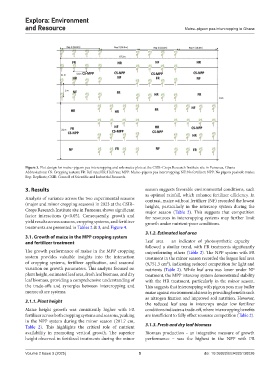
            Figure 3. Plot design for maize–pigeon pea intercropping and sole maize plots at the CSIR–Crops Research Institute site in Fumesua, Ghana
            Abbreviations: CS: Cropping system; FR: Full rate; HR: Half rate; MPP: Maize–pigeon pea intercropping; NF: No fertilizer; NPP: No pigeon pea/sole maize;
            Rep: Replicate; CSIR: Council of Scientific and Industrial Research.

            3. Results                                         season suggests favorable environmental conditions, such
                                                               as optimal rainfall, which enhance fertilizer efficiency. In
            Analysis of variance across the two experimental seasons   contrast, maize without fertilizer (NF) recorded the lowest
            (major and minor cropping seasons) in 2023 at the CSIR–  heights,  particularly  in  the  intercrop  system  during  the
            Crops Research Institute site in Fumesua shows significant   major season (Table 2). This suggests that competition
            factor interactions (p<0.05). Consequently, growth and   for resources in intercropping systems may further limit
            yield results across seasons, cropping systems, and fertilizer   growth under nutrient-poor conditions.
            treatments are presented in Tables 2 & 3, and Figure 4.
                                                               3.1.2. Estimated leaf area
            3.1. Growth of maize in the MPP cropping system
            and fertilizer treatment                           Leaf area – an indicator of photosynthetic capacity –
                                                               followed a similar trend, with FR treatments significantly
            The growth performance of maize in the MPP cropping   outperforming others (Table 2). The NPP system with FR
            system provides valuable insights into the interaction   treatment in the minor season recorded the largest leaf area
            of cropping systems, fertilizer application, and seasonal   (9,751.3 cm²), indicating reduced competition for light and
            variation on growth parameters. This analysis focused on   nutrients (Table 2). While leaf area was lower under NF
            plant height, estimated leaf area, fresh leaf biomass, and dry   treatment, the MPP intercrop system demonstrated stability
            leaf biomass, providing a comprehensive understanding of   with the HR treatment, particularly in the minor season.
            the trade-offs and synergies between intercropping and   This suggests that intercropping with pigeon peas may buffer
            monoculture systems.                               maize against environmental stress by providing benefits such
                                                               as nitrogen fixation and improved soil nutrition. However,
            3.1.1. Plant height                                the  reduced  leaf  area  in  intercrops  under  low  fertilizer
            Maize  height  growth  was  consistently  higher  with  FR   conditions indicates a trade-off, where intercropping benefits
            fertilizer across both cropping systems and seasons, peaking   are insufficient to fully offset resource competition (Table 2).
            in the NPP system during the minor season (201.7  cm,
            Table 2). This highlights the critical role of nutrient   3.1.3. Fresh and dry leaf biomass
            availability in promoting vertical growth. The superior   Biomass production – an integrative measure of growth
            height observed in fertilized treatments during the minor   performance – was the highest in the NPP with FR


            Volume 2 Issue 3 (2025)                         5                           doi: 10.36922/EER025130026

