


Page 49 - EER-2-3
P. 49
Explora: Environment
            and Resource                                                        Maize–pigeon pea intercropping in Ghana


            A                                                  under FR but showed greater variability under low-input
                                                               conditions, indicating lower resilience than intercropping
                                                               (Table 2).
                                                                 These findings highlight a key trade-off: NPP systems
                                                               excel under high input conditions but are vulnerable
                                                               to nutrient and environmental constraints. In contrast,
                                                               the MPP system prioritized stability and sustainability
                                                               over peak productivity (Table 2). The intercrop system’s
                                                               consistent growth under HR and its resilience to seasonal
            B                                                  changes demonstrate its suitability for resource-limited
                                                               environments. In addition, the ecological benefits of pigeon
                                                               peas – such as nitrogen fixation, organic matter addition,
                                                               and soil protection – provide long-term advantages beyond
                                                               immediate growth measurements.
                                                               3.2. Maize growth as influenced by cropping system
                                                               and fertilization
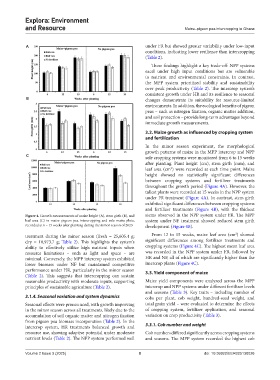
                                                               In the minor season experiment, the morphological
                                                               growth patterns of maize in the MPP intercrop and NPP
            C                                                  sole cropping systems were monitored from 6 to 15 weeks
                                                               after planting. Plant height (cm), stem girth (mm), and
                                                               leaf area (cm ) were recorded at each time point. Maize
                                                                          2
                                                               height showed no statistically significant differences
                                                               between cropping systems and fertilizer treatments
                                                               throughout the growth period (Figure 4A). However, the
                                                               tallest plants were recorded at 15 weeks in the NPP system
                                                               under FR treatment (Figure 4A). In contrast, stem girth
                                                               exhibited significant differences between cropping systems
                                                               and fertilizer treatments (Figure  4B), with the thickest
            Figure 4. Growth measurements of maize height (A), stem girth (B), and   stems observed in the NPP system under FR. The MPP
            leaf area (C) in maize–pigeon pea intercropping and sole maize plots,   system under NF treatment showed reduced stem girth
            recorded at 6 – 15 weeks after planting during the minor season of 2023  development (Figure 4B).

                                                                                                     2
            treatment during the minor season (fresh = 25,605.4  g;   From  12  to  15  weeks,  maize  leaf  area  (cm )  showed
            dry =  10,973.7  g;  Table 2). This highlights  the system’s   significant differences among fertilizer treatments and
            ability  to  effectively  utilize  high  nutrient  inputs  when   cropping systems (Figure 4C). The highest mean leaf area
            resource limitations – such as light and space – are   was recorded in the NPP system under FR, followed by
            minimal. Conversely, the MPP intercrop system exhibited   HR and NF, all of which are significantly higher than the
            lower biomass under NF but maintained competitive   intercrop plants (Figure 4C).
            performance under HR, particularly in the minor season   3.3. Yield component of maize
            (Table 2). This suggests that intercropping can sustain
            reasonable productivity with moderate inputs, supporting   Maize yield components were analyzed across the MPP
            principles of sustainable agriculture (Table 2).   intercrop and NPP systems under different fertilizer levels
                                                               and seasons (Table 3). Key traits – including number of
            3.1.4. Seasonal variation and system dynamics      cobs per plant, cob weight, hundred-seed weight, and
            Seasonal effects were pronounced, with growth improving   total grain yield – were evaluated to determine the effects
            in the minor season across all treatments, likely due to the   of  cropping system,  fertilizer  application, and seasonal
            accumulation of soil organic matter and nitrogen fixation   variation on crop productivity (Table 3).
            from pigeon pea biomass incorporation (Table 2). In the
            intercrop system, HR treatments balanced growth and   3.3.1. Cob number and weight
            resource use, showing adaptive potential under moderate   Cob numbers differed significantly across cropping systems
            nutrient levels (Table 2). The NPP system performed well   and seasons. The MPP system recorded the highest cob


            Volume 2 Issue 3 (2025)                         8                           doi: 10.36922/EER025130026

