


Page 71 - EER-2-3
P. 71
Explora: Environment
            and Resource                                              ZnO and TiO nanoparticles and its impact on chickpeas
                                                                               2

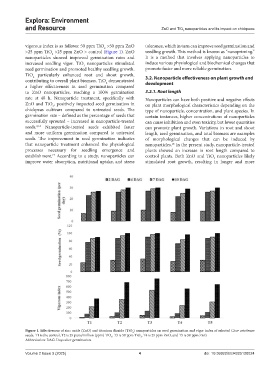
            vigorous index is as follows: 50 ppm TiO  >50 ppm ZnO   tolerance, which in turn can improve seed germination and
                                             2
            >25 ppm TiO  >25 ppm ZnO > control (Figure 1). ZnO   seedling growth. This method is known as “nanopriming.”
                       2
            nanoparticles showed improved germination rates and   It is a method that involves applying nanoparticles to
            increased seedling vigor. TiO  nanoparticles stimulated   induce various physiological and biochemical changes that
                                     2
            seed germination and promoted healthy seedling growth.   promote faster and more reliable germination.
            TiO  particularly enhanced root and shoot growth,
               2
            contributing to overall plant biomass. TiO  demonstrated   3.2. Nanoparticle effectiveness on plant growth and
                                                               development
                                              2
            a higher effectiveness in seed germination compared
            to ZnO nanoparticles, reaching a 100% germination   3.2.1. Root length
            rate at 48  h. Nanoparticle treatment, specifically with   Nanoparticles can have both positive and negative effects
            ZnO and TiO , positively impacted seed germination in   on plant morphological characteristics depending on the
                       2
            chickpeas cultivars compared to untreated seeds. The   type of nanoparticle, concentration, and plant species. In
            germination rate – defined as the percentage of seeds that   certain instances, higher concentrations of nanoparticles
            successfully sprouted – increased in nanoparticle-treated   can cause inhibition and even toxicity, but lower quantities
            seeds.  Nanoparticle-treated seeds exhibited faster   can promote plant growth. Variations in root and shoot
                 4,16
            and more uniform germination compared to untreated   length, seed germination, and total biomass are examples
            seeds. The improvement in seed germination indicates   of morphological changes that can be induced by
            that  nanoparticle  treatment  enhanced  the  physiological   nanoparticles.  In the present study, nanoparticle-treated
                                                                          18
            processes  necessary  for  seedling  emergence  and   plants showed an increase in root length compared to
            establishment.  According to a study, nanoparticles can   control plants.  Both ZnO and TiO  nanoparticles likely
                       17
                                                                                            2
            improve water absorption, nutritional uptake, and stress   stimulated root growth, resulting in longer and more


            Figure 1. Effectiveness of zinc oxide (ZnO) and titanium dioxide (TiO ) nanoparticles on seed germination and vigor index of selected Cicer arietinum
                                                         2
            seeds. T1 is the control, T2 is 25 parts/million (ppm) TiO , T3 is 50 ppm TiO , T4 is 25 ppm ZnO, and T5 is 50 ppm ZnO.
                                                2
                                                             2
            Abbreviation: DAG: Days after germination.
            Volume 2 Issue 3 (2025)                         4                           doi: 10.36922/EER025120024

