


Page 75 - EER-2-3
P. 75
Explora: Environment
            and Resource                                              ZnO and TiO nanoparticles and its impact on chickpeas
                                                                               2


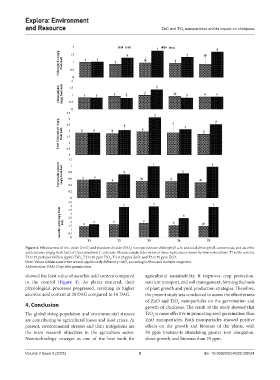
            Figure 4. Effectiveness of zinc oxide (ZnO) and titanium dioxide (TiO ) nanoparticles on chlorophyll a, b, and total chlorophyll, carotenoids, and ascorbic
                                                        2
            acid contents (mg/g fresh leaf) of Cicer arietinum L. cultivars. Mean± standard deviation of three replicates is shown by thin vertical bars. T1 is the control,
            T2 is 25 parts per million (ppm) TiO , T3 is 50 ppm TiO , T4 is 25 ppm ZnO, and T5 is 50 ppm ZnO.
                                   2
                                                2
            Note: Values within same letter are not significantly different p<0.05, according to Duncan’s multiple range test.
            Abbreviation: DAG: Days after germination.
            showed the least value of ascorbic acid content compared   agricultural  sustainability.  It  improves  crop  protection,
            to the control (Figure  4). As plants matured, their   nutrient transport, and soil management, forming the basis
            physiological processes progressed, resulting in higher   of plant growth and yield production strategies. Therefore,
            ascorbic acid content at 20 DAG compared to 10 DAG.  the present study was conducted to assess the effectiveness
                                                               of ZnO and TiO  nanoparticles on the germination and
            4. Conclusion                                      growth of chickpeas. The result of the study showed that
                                                                             2
            The global rising population and environmental stresses   TiO  is more effective in promoting seed germination than
                                                                  2
            are contributing to agricultural losses and food crises. At   ZnO nanoparticles. Both nanoparticles showed positive
            present, environmental stresses and their mitigations are   effects on the growth and biomass of the plants, with
            the main research objectives in the agriculture sector.   50  ppm treatments stimulating greater root elongation,
            Nanotechnology emerges as one of the best tools for   shoot growth, and biomass than 25 ppm.


            Volume 2 Issue 3 (2025)                         8                           doi: 10.36922/EER025120024

