


Page 73 - EER-2-3
P. 73
Explora: Environment
            and Resource                                              ZnO and TiO nanoparticles and its impact on chickpeas
                                                                               2

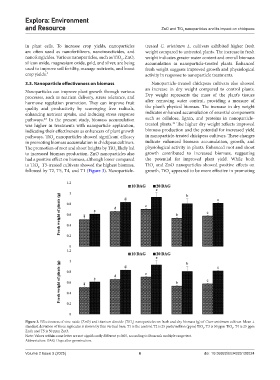
            in plant cells. To increase crop yields, nanoparticles   treated  C. arietinum L. cultivars exhibited higher fresh
            are often used as nanofertilizers, nanoinsecticides, and   weight compared to untreated plants. The increase in fresh
            nanofungicides. Various nanoparticles, such as TiO , ZnO,   weight indicates greater water content and overall biomass
                                                     2
            silicon oxide, magnesium oxide, gold, and silver, are being   accumulation in  nanoparticle-treated plants.  Enhanced
            used to improve soil fertility, manage nutrients, and boost   fresh weight suggests improved growth and physiological
            crop yields. 4                                     activity in response to nanoparticle treatments.
            3.3. Nanoparticle effectiveness on biomass           Nanoparticle-treated chickpeas cultivars also showed
                                                               an increase in dry weight compared to control plants.
            Nanoparticles can improve plant growth through various
            processes, such as nutrient delivery, stress tolerance, and   Dry weight represents the mass of the plant’s tissues
            hormone regulation promotion. They can improve fruit   after removing water content, providing a measure of
            quality and productivity by scavenging free radicals,   the  plant’s  physical  biomass.  The increase  in dry  weight
            enhancing nutrient uptake, and inducing stress response   indicates enhanced accumulation of essential components
            pathways.  In the present study, biomass accumulation   such as cellulose, lignin, and proteins in nanoparticle-
                    4,9
                                                                          19
            was  higher in  treatments with nanoparticle  application,   treated plants.  The higher dry weight reflects improved
            indicating their effectiveness as enhancers of plant growth   biomass production and the potential for increased yield
            pathways. TiO  nanoparticles showed significant efficacy   in nanoparticle-treated chickpeas cultivars. These changes
                        2
            in promoting biomass accumulation in chickpeas cultivars.   indicate enhanced biomass accumulation, growth, and
            The promotion of root and shoot heights by TiO  likely led   physiological activity in plants. Enhanced root and shoot
                                                  2
            to increased biomass production. ZnO nanoparticles also   growth contributed to increased biomass, suggesting
            had a positive effect on biomass, although lower compared   the  potential  for  improved  plant  yield.  While  both
            to TiO . T3-treated cultivars showed the highest biomass,   TiO  and ZnO nanoparticles showed positive effects on
                                                                  2
                 2
            followed by T2, T5, T4, and T1 (Figure 3). Nanoparticle-  growth, TiO  appeared to be more effective in promoting
                                                                         2


            Figure 3. Effectiveness of zinc oxide (ZnO) and titanium dioxide (TiO ) nanoparticles on fresh and dry biomass (g) of Cicer arietinum cultivar. Mean ±
                                                         2
            standard deviation of three replicates is shown by thin vertical bars. T1 is the control, T2 is 25 parts/million (ppm) TiO , T3 is 50 ppm TiO , T4 is 25 ppm
                                                                                       2
                                                                                                    2
            ZnO, and T5 is 50 ppm ZnO.
            Note: Values within same letter are not significantly different p<0.05, according to Duncan’s multiple range test.
            Abbreviation: DAG: Days after germination.
            Volume 2 Issue 3 (2025)                         6                           doi: 10.36922/EER025120024

