


Page 72 - EER-2-3
P. 72
Explora: Environment
            and Resource                                              ZnO and TiO nanoparticles and its impact on chickpeas
                                                                               2

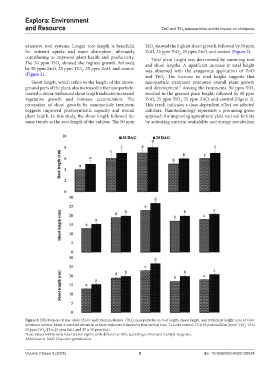
            extensive root systems.  Longer root length is beneficial   TiO  showed the highest shoot growth, followed by 50 ppm
                                                                  2
            for  nutrient  uptake  and water  absorption, ultimately   ZnO, 25 ppm TiO , 25 ppm ZnO, and control (Figure 2).
                                                                             2
            contributing to improved plant health and productivity.   Total plant height was determined by summing root
            The 50  ppm TiO  showed the highest growth, followed   and shoot lengths. A  significant increase in total height
                          2
            by 50 ppm ZnO, 25 ppm TiO , 25 ppm ZnO, and control   was  observed  with  the  exogenous  application  of  ZnO
                                    2
            (Figure 2).                                        and TiO . The  increase in  total  height  suggests  that
                                                                      2
              Shoot length, which refers to the length of the above-  nanoparticle treatment promoted overall plant growth
            ground parts of the plant, also increased in the nanoparticle-  and development.  Among the treatments, 50 ppm TiO
                                                                             9
                                                                                                             2
            treated cultivar. Enhanced shoot length indicates increased   resulted in the greatest plant height, followed by 50 ppm
            vegetative growth and biomass accumulation.  The   ZnO, 25 ppm TiO , 25 ppm ZnO, and control (Figure 2).
                                                                              2
            promotion of shoot growth by nanoparticle treatment   This result indicates a dose-dependent effect on selected
            suggests improved photosynthetic capacity and overall   cultivars. Nanotechnology represents a promising green
            plant health. In this study, the shoot length followed the   approach for improving agricultural yield and soil fertility
            same trends as the root length of the cultivar. The 50 ppm   by activating nutrient availability and energy metabolism


            Figure 2. Effectiveness of zinc oxide (ZnO) and titanium dioxide (TiO ) nanoparticles on root length, shoot length, and total plant height (cm) of Cicer
                                                         2
            arietinum cultivar. Mean ± standard deviation of three replicates is shown by thin vertical bars. T1 is the control, T2 is 25 parts/million (ppm) TiO , T3 is
                                                                                                         2
            50 ppm TiO , T4 is 25 ppm ZnO, and T5 is 50 ppm ZnO.
                    2
            Note: Values within same letter are not significantly different p<0.05, according to Duncan’s multiple range test.
            Abbreviation: DAG: Days after germination.
            Volume 2 Issue 3 (2025)                         5                           doi: 10.36922/EER025120024

