


Page 81 - EER-2-3
P. 81
Explora: Environment
            and Resource                                            The development of the river chief in Nantong and Huzhou


            2. Methods and data                                chief  that were issued by all levels of the  administrative
                                                               hierarchy associated with Wuxi, Nantong, and Huzhou.
            This study is designed around a traditional small-n case   The documents included among others: policy texts,
            study,  which takes the transfer of the river chief system   legislative releases, manuals, and the One River and
                41
            from Wuxi as an example of how different motivational   One Policy plan. 41,42  To support this data, we also
            factors and structural  constraints  impact  the transfer   examined official government work reports associated
            process and outcomes. Specifically, we selected two   with the implementation of the two river chief systems
            representative prefecture-level cities to observe how they   and performance evaluation reports of river and lake
            transfer the river chief model. The idea was to investigate   management and protection in the two regions.
            the effect of modifying a model on the outcomes in the
            transferring jurisdiction. We selected Nantong because   In addition, we consulted a range of secondary
            it lies in Jiangsu Province, which was the home of Wuxi,   documents extending from official press releases-
            thus reducing the environmental differences discussed   relevant articles and news stories (both in Chinese and
            above. Besides, the transfer occurred after the higher-level   English) to organizational reports issued by international
            provincial government introduced a requirement that all   organizations (such as the World Wide Fund for Nature)
                                                               and international  governing  organizations  (such  as the
            municipalities produce river chiefs. This requirement not   World Bank and the International Monetary Fund).
            only provided an incentive for engaging in the transfer
            process, but also set a base model for the jurisdictions that   To gather this data, we utilized open websites found
            had not already developed their river chief systems in the   through  DuckDuckGo  and  Google  searches,  internal
            province.                                          ministerial and government search engines, institutional
                                                               databases (Web of Science), and archival research within
              Our second case, Huzhou, was selected as a comparison   relevant ministries and departments. To prevent being
            case as it fell under the jurisdiction of Zhejiang Province.   overly influenced by the tendency to promote political
            This provided a different setting and underlying structural   performance in official reports, we also collected social
            factors from those that embedded actors in Nantong. In   media reports and interviews to strengthen our research
            addition, unlike Nantong, Huzhou transferred the river   findings. Finally, based on 40,000 words (in Chinese) of
            chief system without being subjected to a requirement from   case material, the qualitative data analysis software NVivo
            the Zhejiang Provincial authorities. This allowed Huzhou   10.0 (Lumivero, USA) was used for coding and recording
            a degree of freedom in transferring and developing its   the text.
            river chief system that is unavailable to policymakers in
            Nantong. We argue that this structural difference (when   With the support of the National Social Science Fund
            combined with other motivational factors) led to a much   of China, we also conducted a series of field investigations
            more dynamic river chief policy based on a mixture of what   in Nantong and Huzhou between October and November
            others had done but modified to better fit their context and   2019. These consisted of 26 semi-structured interviews with
                                                               the staff of the river chief’s office in the two municipalities.
            needs.
                                                               These interviews were semi-structured and based on the
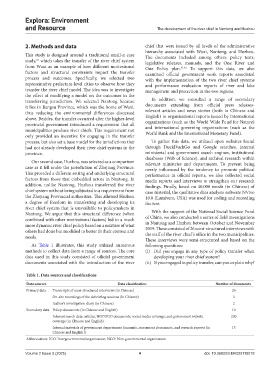
              As  Table  1 illustrates, this study utilized numerous   following questions:
            methods to collect data from a range of sources. The core   (i)  Did you engage in any type of policy transfer when
            data used in this study consisted of official government   developing your river chief system?
            documents associated with the introduction of the river   (ii)  If you engaged in policy transfer, can you explain why?

            Table 1. Data sources and classifications

            Data sources                           Data classification                       Number of documents
            Primary data  Transcripts of semi-structured interviews (in Chinese)                    26
                       On-site recordings of the debriefing sessions (in Chinese)                   3
                       Author’s investigation diary (in Chinese)                                    2
            Secondary data Policy documents (in Chinese and English)                                10
                       Internet search data: articles, NGO/IGO documents, social media coverage, and government website   200
                       coverage (in Chinese and English)
                       Internal materials of government departments (manuals, assessment documents, and research reports [in   15
                       Chinese and English])
            Abbreviations: IGO: Intergovernmental organization; NGO: Non-governmental organization.


            Volume 2 Issue 3 (2025)                         4                           doi: 10.36922/EER025110018

