


Page 191 - EJMO-9-1
P. 191
Eurasian Journal of Medicine and
            Oncology
                                                                                Research on hypoxia and ECM in cancer


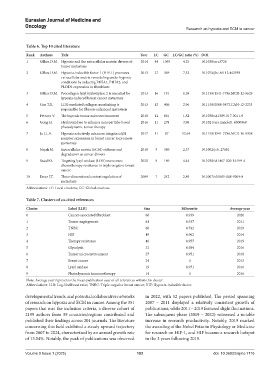
            Table 6. Top 10 cited literature
            Rank  Authors  Title                             Year  LC  GC  LC/GC ratio (%) DOI
            1     Gilkes D.M. Hypoxia and the extracellular matrix: drivers of   2014  44  1035  4.25  10.1038/nrc3726
                           tumor metastasis
            2     Gilkes D.M. Hypoxia-inducible factor 1 (HIF-1) promotes   2013  27  369  7.32  10.1074/jbc.M112.442939
                           extracellular matrix remodeling under hypoxic
                           conditions by inducing P4HA1, P4HA2, and
                           PLOD2 expression in fibroblasts
            3     Gilkes D.M. Procollagen lysyl hydroxylase 2 is essential for   2013  16  191  8.38  10.1158/1541-7786.MCR-12-0629
                           hypoxia-induced breast cancer metastasis
            4     Cox T.R.  LOX-mediated collagen crosslinking is   2013  12  406  2.96  10.1158/0008-5472.CAN-12-2233
                           responsible for fibrosis-enhanced metastasis
            5     Petrova V.  The hypoxic tumor microenvironment  2018  12  661  1.82  10.1038/s41389-017-0011-9
            6     Gong H.  Hyaluronidase to enhance nanoparticle-based   2016  11  278  3.96  10.1021/acs.nanolett. 6b00068
                           photodynamic tumor therapy
            7     Ju J.L.A.  Hypoxia selectively enhances integrin α5β1   2017  11  87  12.64  10.1158/1541-7786.MCR-16-0338
                           receptor expression in breast cancer to promote
                           metastasis
            8     Najafi M.  Extracellular matrix (ECM) stiffness and   2019  9  380  2.37  10.1002/jcb. 27681
                           degradation as cancer drivers
            9     Saatcl O.  Targeting lysyl oxidase (LOX) overcomes   2020  8  180  4.44  10.1038/s41467-020-16199-4
                           chemotherapy resistance in triple-negative breast
                           cancer
            10    Ereer J.T.  Three-dimensional context regulation of   2009  7  242  2.89  10.1007/s10585-008-9209-8
                           metastasis
            Abbreviations: LC: Local citations; GC: Global citations.

            Table 7. Clusters of co‑cited references

            Cluster           Label (LLR)                     Size            Silhouette           Average year
            0                 Cancer-associated fibroblast     66               0.939                 2020
            1                 Tumor angiogenesis               61               0.937                 2011
            2                 TNBC                             60               0.742                 2019
            3                 HIF                              49               0.962                 2014
            4                 Therapy resistance               40               0.957                 2019
            5                 Glycolysis                       32               0.984                 2016
            6                 Tumor microenvironment           27               0.951                 2018
            7                 Breast cancer                    24                1                    2013
            8                 Lysyl oxidase                    19               0.971                 2016
            9                 Photodynamic immunotherapy       14                1                    2016
            Note: Average year represents the mean publication year of all references within this cluster.
            Abbreviations: LLR: Log-likelihood ratio; TNBC: Triple-negative breast cancer; HIF: Hypoxia-inducible factor.

            developmental trends, and potential collaborative networks   in 2022, with 52 papers published. The period spanning
            of research on hypoxia and ECM in cancer. Among the 351   2007  –  2011 displayed  a relatively  consistent  growth  of
            papers that met the inclusion criteria, a diverse cohort of   publications, while 2011 – 2019 featured slight fluctuations.
            2199 authors from 39 countries/regions contributed and   The subsequent phase (2019 – 2022) witnessed a notable
            published their findings across 201 journals. The literature   increase  in  research  productivity. Notably,  2019 marked
            concerning this field exhibited a steady upward trajectory   the awarding of the Nobel Prize in Physiology or Medicine
            from 2007 to 2024, characterized by an annual growth rate   for research on HIF-1, and HIF became a research hotspot
            of 13.54%. Notably, the peak of publications was observed   in the 3 years following 2019.


            Volume 9 Issue 1 (2025)                        183                              doi: 10.36922/ejmo.7116

