


Page 237 - EJMO-9-1
P. 237
Eurasian Journal of Medicine and
            Oncology
                                                                                    Grains, legumes, and gastric cancer


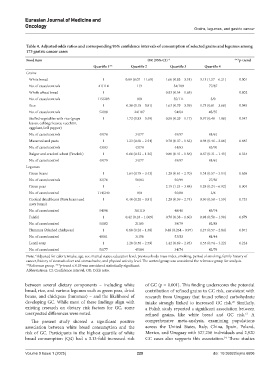
            Table 4. Adjusted odds ratios and corresponding 95% confidence intervals of consumption of selected grains and legumes among
            173 gastric cancer cases
            Food item                                           OR (95% CI) *                        ***p‑trend
                                         Quartile 1**    Quartile 2      Quartile 3     Quartile 4
            Grains
             White bread                     1        0.89 (0.07 – 11.69)  1.66 (0.83 – 3.31)  3.13 (1.57 – 6.21)  0.001
             No. of cases/controls         41/114          1/3             54/109         77/87
             Whole wheat bread               1              -           0.93 (0.54 – 1.63)  -          0.802
             No. of cases/controls        115/203          0/0             55/111          3/0
             Rice                            1         0.38 (0.18 – 0.81)  1.63 (0.79 – 3.39)  1.73 (0.81 – 3.68)  0.045
             No. of cases/controls         52/88          24/107           54/64          43/55
             Stuffed vegetables with rice (grape   1   1.72 (0.83 – 3.59)  0.58 (0.29 – 1.17)  0.97 (0.48 – 1.98)  0.347
             leaves, cabbage leaves, zucchini,
             eggplant, bell pepper)
             No. of cases/controls         49/78           34/77           49/97          41/61
             Macaroni and pasta              1         1.23 (0.60 – 2.54)  0.78 (0.37 – 1.63)  0.98 (0.46 – 2.06)  0.487
             No. of cases/controls         43/83           43/78           44/83          43/70
             Bulgur and cracked wheat (Freekeh)  1     0.66 (0.32 – 1.36)  0.80 (0.41 – 1.56)  0.67 (0.31 – 1.45)  0.334
             No. of cases/control          49/79           34/77           49/97          41/61
            Legumes
             Green beans                     1         1.64 (0.78 – 3.43)  1.28 (0.61 – 2.70)  1.34 (0.57 – 3.14)  0.638
             No. of cases/controls         32/76           58/83           56/99          27/56
             Green peas                      1              -           2.19 (1.24 – 3.88)  1.28 (0.24 – 6.92)  0.004
             No. of cases/control         114/240          0/0             56/68           3/6
             Cooked dried beans (Fava beans and   1    0.40 (0.20 – 0.81)  1.28 (0.59 – 2.74)  0.96 (0.58 – 1.59)  0.733
             navy beans)
             No. of cases/control          54/90          36/110           40/40          45/74
             Falafel                         1        0.42 (0.18 – 1.009)  0.78 (0.38 – 1.60)  0.98 (0.50 – 1.90)  0.679
             No. of cases/control          51/82           21/65           39/79          62/88
             Hummus (Mashed chickpeas)       1         0.60 (0.26 – 1.38)  0.48 (0.264 – 0.97)  1.27 (0.57 – 2.84)  0.871
             No. of cases/control          48/61           31/56           53/53          41/44
             Lentil soup                     1         1.20 (0.56 – 2.59)  1.42 (0.69 – 2.93)  1.55 (0.74 – 3.22)  0.224
             No. of cases/control          51/77           45/84           34/74          42/79
            Note: *Adjusted for caloric intake, age, sex, marital status, education level, previous body mass index, smoking, period of smoking, family history of
            cancer, history of stomach ulcer and stomachache, and physical activity level. The control group was considered the reference group for analysis.
            **Reference group. ***p-trend ≤ 0.05 was considered statistically significant.
            Abbreviations: CI: Confidence interval; OR: Odds ratio.


            between several dietary components  – including white   of GC (p = 0.001). This finding underscores the potential
            bread, rice, and various legumes such as green peas, dried   contribution of refined grains to GC risk, consistent with
            beans, and chickpeas (hummus) – and the likelihood of   research from Uruguay that found refined carbohydrate
            developing GC. While most of these findings align with   intake strongly linked to increased GC risk.  Similarly,
                                                                                                    23
            existing research on dietary risk factors for GC, some   a Polish study reported a significant association between
            unexpected differences were noted.                 refined grains, like white bread and GC risk.  A
                                                                                                         13
              The present study showed a significant positive   comprehensive meta-analysis, examining populations
            association between white bread consumption and the   across the United States, Italy, China, Spain, Poland,
            risk of GC. Participants in the highest quartile of white   Mexico, and Uruguay with 527,256 individuals and 2,920
            bread consumption (Q4)  had a 3.13-fold increased risk   GC  cases  also  supports  this  association.   These  studies
                                                                                                14

            Volume 9 Issue 1 (2025)                        229                              doi: 10.36922/ejmo.6606

